
Attention Sinks and Outliers in Attention Residuals
Haozheng Luo ⋅ Haoran Dai ⋅ Shaoyang Zhang ⋅ Xi Chen ⋅ Eric Hanchen Jiang ⋅ Yijiang Li ⋅ Ching-Yuen Huang ⋅ Chenghao Qiu ⋅ Chenwei Xu ⋅ Zhenyu Pan ⋅ Haotian Zhang ⋅ Binghui Wang ⋅ Yan Chen
Abstract
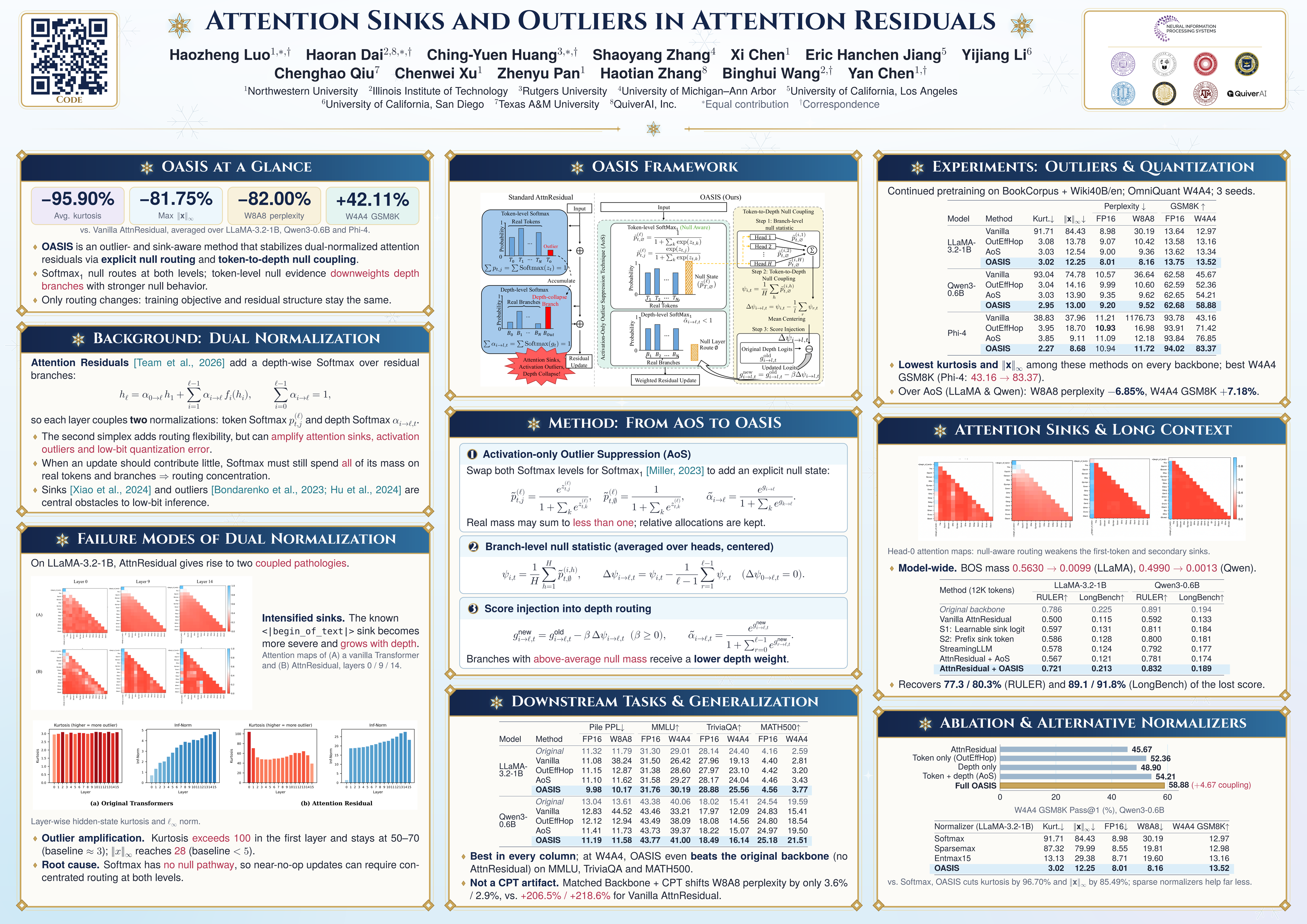
We propose OASIS, an outlier- and sink-aware technique built on inter-layer null signaling. As AttnResidual architectures introduce an additional depth-wise normalization channel, they improve inter-layer routing flexibility but also exacerbate attention sinks, activation outliers, and the resulting degradation in inference stability and quantization robustness. OASIS addresses this issue by introducing a $\mathop{\rm{Softmax}}_1$-based null space and coupling token-level null evidence to depth routing through an inter-layer null signal, thereby reducing sink-dominated routing and improving structural robustness. Theoretically, we show that the dual-normalization design of AttnResidual intensifies sink formation and quantization brittleness. Experimentally, we compare OASIS against five baselines on three real-world datasets and observe consistent improvements in both attention sink and post-quantization performance. Notably, OASIS achieves an average reduction of 9.26\% in maximum infinity norm and 2.60\% in average kurtosis across the evaluated settings, while lowering perplexity by 75.85\% under W8A8 and improving GSM8K Pass@1 by 12.42\% under W4A4.
Chat is not available.
Successful Page Load