
Poster Session
Mexico City Poster Session 6
LoRA-EnVar: Parameter-Efficient Hybrid Ensemble Variational Assimilation for Weather Forecasting
Yi Xiao ⋅ Hang Fan ⋅ Kun Chen ⋅ Ye Cao ⋅ Ben Fei ⋅ Wei Xue ⋅ LEI BAI
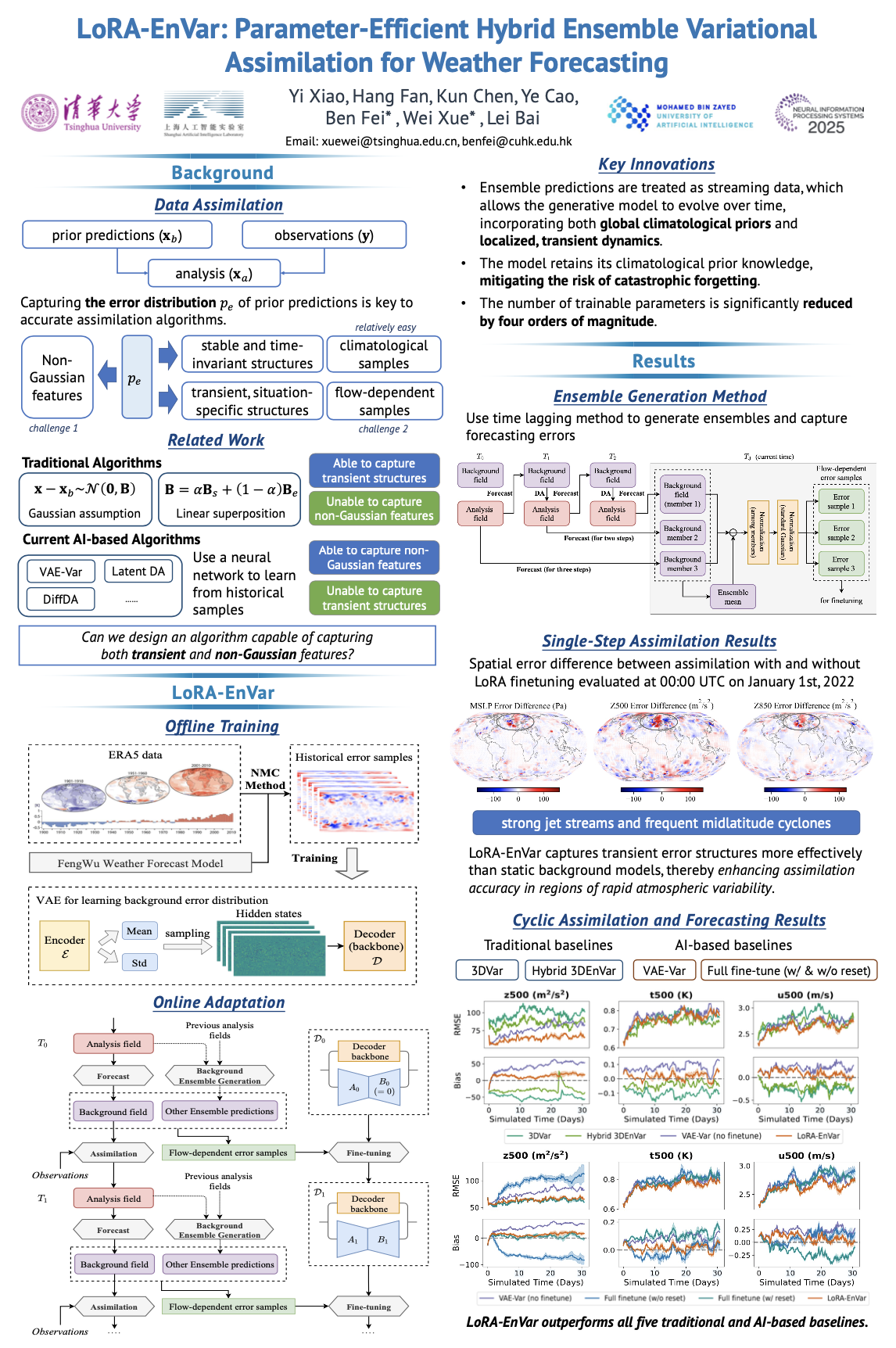
Accurate estimation of background error (i.e., forecast error) distribution is critical for effective data assimilation (DA) in numerical weather prediction (NWP). In state-of-the-art operational DA systems, it is common to account for the temporal evolution of background errors by employing hybrid methods, which blend a static climatological covariance with a flow-dependent ensemble-derived component. While effective to some extent, these methods typically assume Gaussian-distributed errors and rely heavily on hand-crafted covariance structures and domain expertise, limiting their ability to capture the complex, non-Gaussian nature of atmospheric dynamics. In this work, we propose LoRA-EnVar, a novel hybrid ensemble variational DA algorithm that integrates low-rank adaptation (LoRA) into a deep generative modeling framework. We first learn a climatological background error distribution using a variational autoencoder (VAE) trained on historical data. To incorporate flow-dependent uncertainty, we introduce LoRA modules that efficiently adapt the learned distribution in response to flow-dependent ensemble perturbations. Our approach supports online finetuning, enabling dynamic updates of the background error distribution without catastrophic forgetting. We validate LoRA-EnVar in high-resolution assimilation settings using the FengWu forecast model and simulated observations from ERA5 reanalysis. Experimental results show that LoRA-EnVar significantly improves assimilation accuracy over models assuming static background error distribution and achieves comparable or better performance than full finetuning while reducing the number of trainable parameters by three orders of magnitude. This demonstrates the potential of parameter-efficient adaptation for scalable, non-Gaussian DA in operational meteorology.
Afterburner: Reinforcement Learning Facilitates Self-Improving Code Efficiency Optimization
Mingzhe Du ⋅ Anh Tuan Luu ⋅ Yue Liu ⋅ Yuhao Qing ⋅ Dong HUANG ⋅ Xinyi He ⋅ Qian Liu ⋅ Zejun MA ⋅ See-Kiong Ng
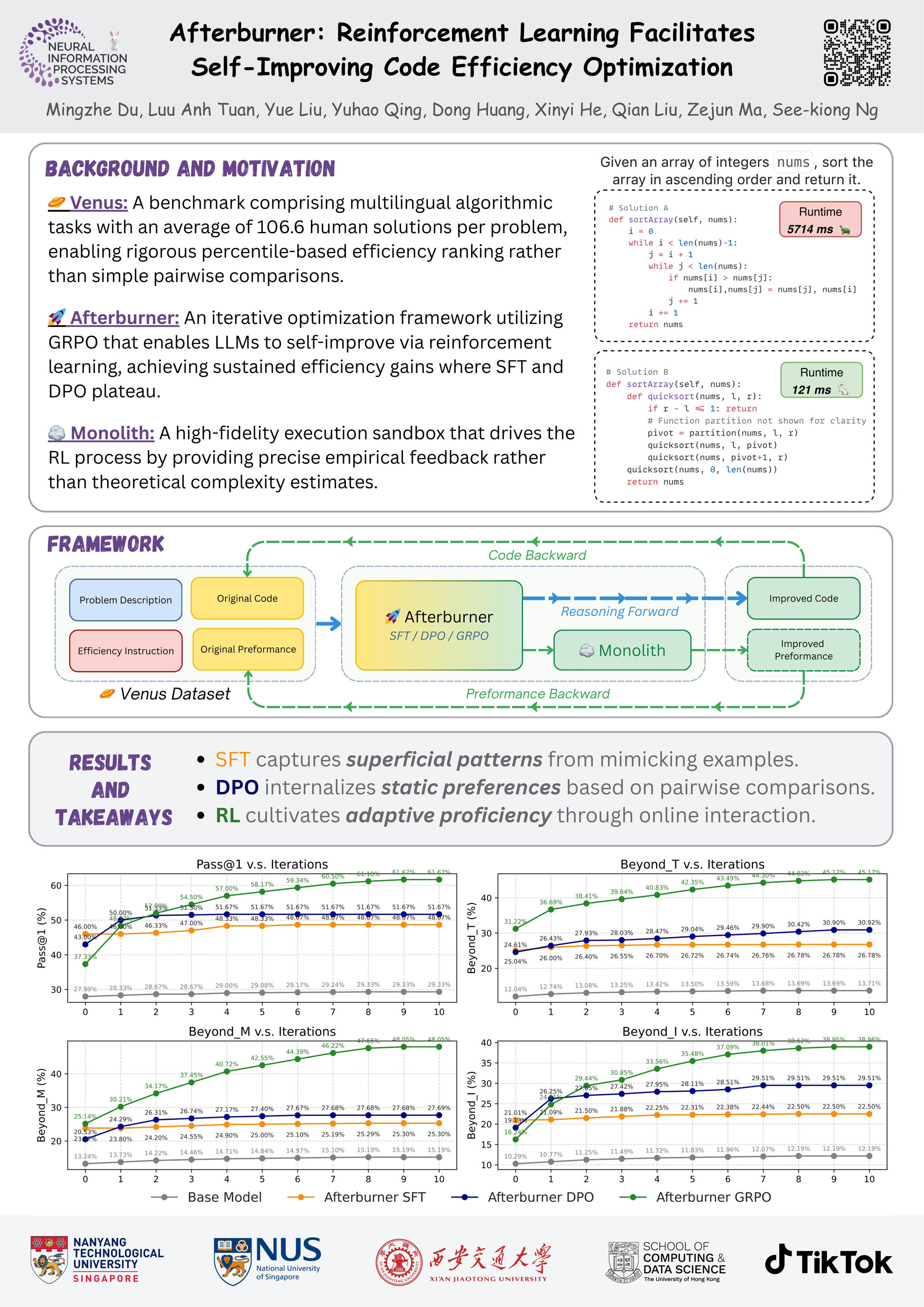
Large Language Models (LLMs) generate functionally correct solutions but often fall short in code efficiency, a critical bottleneck for real-world deployment. In this paper, we introduce a novel test-time iterative optimization framework to address this, employing a closed-loop system where LLMs iteratively refine code based on empirical performance feedback from an execution sandbox. We explore three training strategies: Supervised Fine-Tuning (SFT), Direct Preference Optimization (DPO), and Group Relative Policy Optimization~(GRPO). Experiments on our Venus dataset and the APPS benchmark show that SFT and DPO rapidly saturate in efficiency gains. In contrast, GRPO, using reinforcement learning (RL) with execution feedback, continuously optimizes code performance, significantly boosting both pass@1 (from 47% to 62%) and the likelihood of outperforming human submissions in efficiency (from 31% to 45%). Our work demonstrates effective test-time code efficiency improvement and critically reveals the power of RL in teaching LLMs to truly self-improve code efficiency. We released our code and data at https://github.com/Elfsong/Afterburner.
F-Adapter: Frequency-Adaptive Parameter-Efficient Fine-Tuning in Scientific Machine Learning
Hangwei Zhang ⋅ Chun Kang ⋅ Yan Wang ⋅ Difan Zou
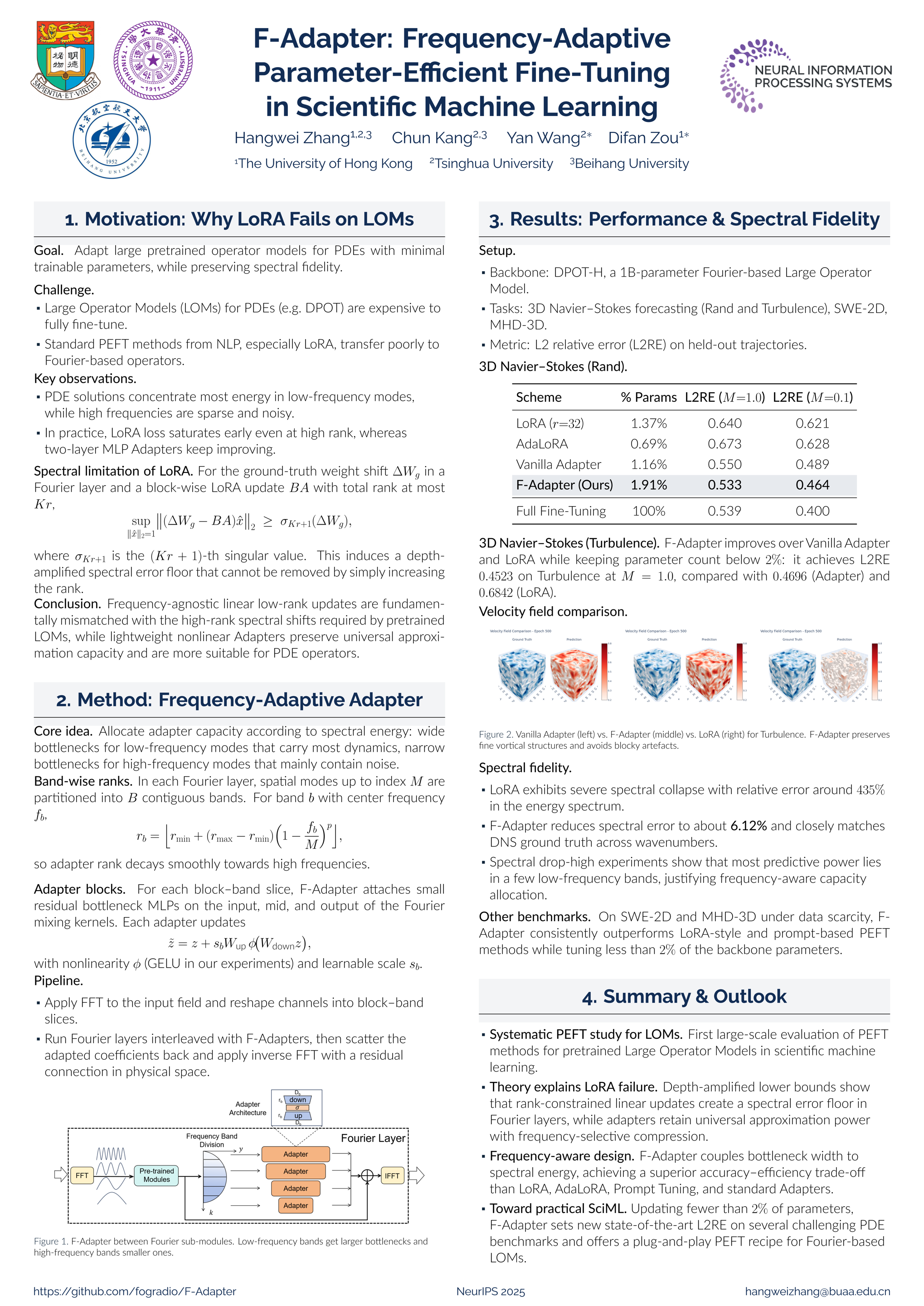
Parameter-efficient fine-tuning (PEFT) powerful pre-trained models for complex downstream tasks has proven effective in vision and language processing, yet this paradigm remains unexplored in scientific machine learning, where the objective is to model complex physical systems. We conduct the first systematic study of PEFT for pre-trained Large Operator Models (LOMs) obtained by scaling variants of Fourier Neural Operator. We observe that the widely used Low-Rank Adaptation (LoRA) yields markedly poorer performance on LOMs than Adapter tuning. We further theoretically establish that stacked LoRA incurs a depth-amplified lower bound on approximation error within Fourier layers, whereas adapters retain universal approximation capacity and, by concentrating parameters on energy-dominant low-frequency modes, attain exponentially decaying error with bottleneck width in the Fourier domain. Motivated by the robust empirical gains of adapters and by our theoretical characterization of PDE solutions as spectrally sparse, we introduce Frequency-Adaptive Adapter (F-Adapter). F-Adapter allocates adapter capacity based on spectral complexity, assigning higher-dimension modules to low-frequency components and lower-dimension modules to high-frequency components. Our F-Adapters establish state-of-the-art results on multiple challenging 3D Navier–Stokes benchmarks, markedly enhancing both generalization and spectral fidelity over LoRA and other PEFT techniques commonly used in LLMs. To the best of our knowledge, this work is the first to explore PEFT for scientific machine-learning and establishes F-Adapter as an effective paradigm for this domain. The code will be made publicly available upon acceptance.
SPARTAN: A Sparse Transformer World Model Attending to What Matters
Anson Lei ⋅ Bernhard Schölkopf ⋅ Ingmar Posner
Capturing the interactions between entities in a structured way plays a central role in world models that flexibly adapt to changes in the environment. Recent works motivate the benefits of models that explicitly represent the structure of interactions and formulate the problem as discovering local causal structures. In this work, we demonstrate that reliably capturing these relationships in complex settings remains challenging. To remedy this shortcoming, we postulate that sparsity is a critical ingredient for the discovery of such local structures. To this end we present the SPARse TrANsformer World model (SPARTAN), a Transformer-based world model that learns context-dependent interaction structures between entities in a scene. By applying sparsity regularisation on the attention patterns between object-factored tokens, SPARTAN learns sparse, context-dependent interaction graphs that accurately predict future object states. We further extend our model to adapt to sparse interventions with unknown targets on the dynamics of the environment. This results in a highly interpretable world model that can efficiently adapt to changes. Empirically, we evaluate SPARTAN against the current state-of-the-art in object-centric world models on observation-based environments and demonstrate that our model can learn local causal graphs that accurately reflects the underlying interactions between objects and achieve significantly improved few-shot adaptation to dynamics changes as well as robustness against distractors.
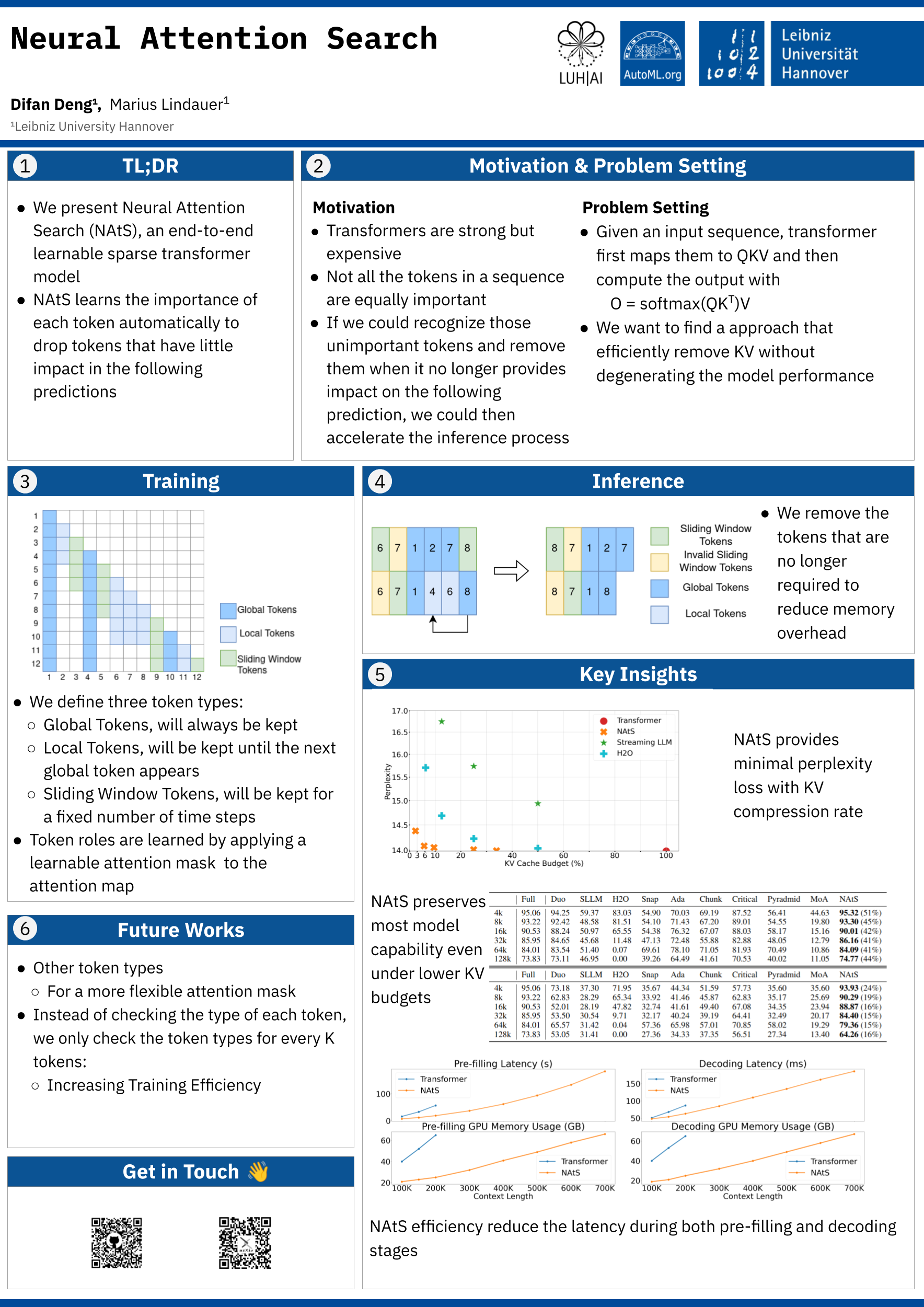
We present Neural Attention Search (NAtS), an end-to-end learnable sparse transformer that automatically evaluates the importance of each token within a sequence and determines if the corresponding token can be dropped after several steps. To this end, we design a search space that contains three token types: (i) Global Tokens will be preserved and queried by all the following tokens. (ii) Local Tokens survive until the next global token appears. (iii) Sliding Window Tokens have an impact on the inference of a fixed size of the next following tokens. Similar to the One-Shot Neural Architecture Search approach, this token-type information can be learned jointly with the architecture weights via a learnable attention mask. Experiments on both training a new transformer from scratch and fine-tuning existing large language models show that NAtS can efficiently reduce the KV cache and the inference costs for the transformer-based models while maintaining the models' performance.
A Dynamic Learning Strategy for Dempster-Shafer Theory with Applications in Classification and Enhancement
Linlin Fan ⋅ Xingyu Liu ⋅ Mingliang Zhou ⋅ Xuekai Wei ⋅ Weizhi Xian ⋅ Jielu Yan ⋅ Weijia Jia
Effective modelling of uncertain information is crucial for quantifying uncertainty. Dempster–Shafer evidence (DSE) theory is a widely recognized approach for handling uncertain information. However, current methods often neglect the inherent a priori information within data during modelling, and imbalanced data lead to insufficient attention to key information in the model. To address these limitations, this paper presents a dynamic learning strategy based on nonuniform splitting mechanism and Hilbert space mapping. First, the framework uses a nonuniform splitting mechanism to dynamically adjust the weights of data subsets and combines the diffusion factor to effectively incorporate the data a priori information, thereby flexibly addressing uncertainty and conflict. Second, the conflict in the information fusion process is reduced by Hilbert space mapping. Experimental results on multiple tasks show that the proposed method significantly outperforms state-of-the-art methods and effectively improves the performance of classification and low-light image enhancement (LLIE) tasks. The code is available at https://anonymous.4open.science/r/Third-ED16.
AffordBot: 3D Fine-grained Embodied Reasoning via Multimodal Large Language Models
Xinyi Wang ⋅ Xun Yang ⋅ Yanlong Xu ⋅ Yuchen Wu ⋅ Zhen Li ⋅ Na Zhao
Effective human-agent collaboration in physical environments requires understanding not only what to act upon, but also where the actionable elements are and how to interact with them. Existing approaches often operate at the object level or disjointedly handle fine-grained affordance reasoning, lacking coherent, instruction-driven grounding and reasoning. In this work, we introduce a new task: Fine-grained 3D Embodied Reasoning, which requires an agent to predict, for each referenced affordance element in a 3D scene, a structured triplet comprising its spatial location, motion type, and motion axis, based on a task instruction. To solve this task, we propose AffordBot, a novel framework that integrates Multimodal Large Language Models (MLLMs) with a tailored chain-of-thought (CoT) reasoning paradigm. To bridge the gap between 3D input and 2D-compatible MLLMs, we render surround-view images of the scene and project 3D element candidates into these views, forming a rich visual representation aligned with the scene geometry. Our CoT pipeline begins with an active perception stage, prompting the MLLM to select the most informative viewpoint based on the instruction, before proceeding with step-by-step reasoning to localize affordance elements and infer plausible interaction motions. Evaluated on the SceneFun3D dataset, AffordBot achieves state-of-the-art performance, demonstrating strong generalization and physically grounded reasoning with only 3D point cloud input and MLLMs. Our code is available at https://github.com/hannahwxy/AffordBot.
Aligning What Matters: Masked Latent Adaptation for Text-to-Audio-Video Generation
Jiyang Zheng ⋅ Siqi Pan ⋅ Yu Yao ⋅ Zhaoqing Wang ⋅ Dadong Wang ⋅ Tongliang Liu
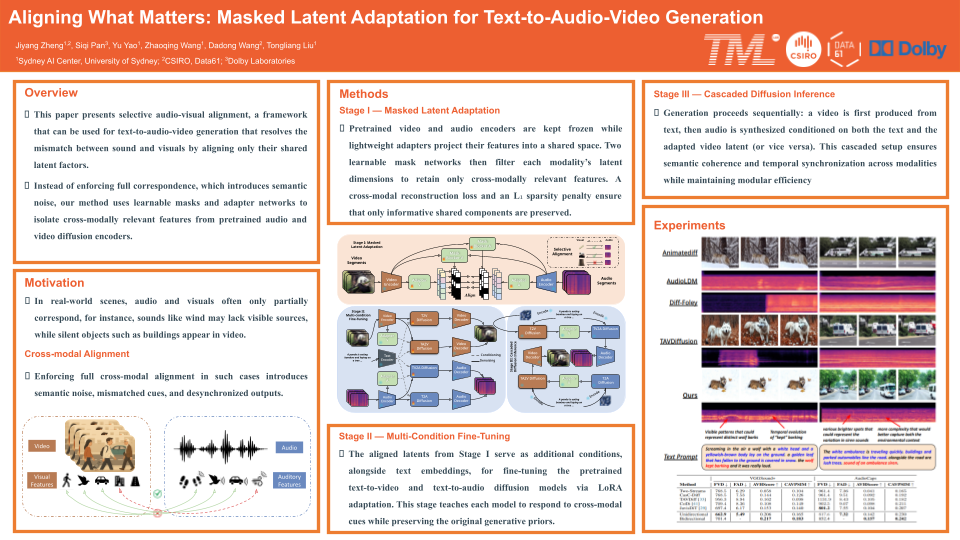
Text-to-Audio-Video (T2AV) generation aims to produce temporally and semantically aligned visual and auditory content from natural language descriptions. While recent progress in text-to-audio and text-to-video models has improved generation quality within each modality, jointly modeling them remains challenging due to incomplete and asymmetric correspondence: audio often reflects only a subset of the visual scene, and vice versa. Naively enforcing full alignment introduces semantic noise and temporal mismatches. To address this, we propose a novel framework that performs selective cross-modal alignment through a learnable masking mechanism, enabling the model to isolate and align only the shared latent components relevant to both modalities. This mechanism is integrated into an adaptation module that interfaces with pretrained encoders and decoders from latent video and audio diffusion models, preserving their generative capacity with reduced training overhead. Theoretically, we show that our masked objective provably recovers the minimal set of shared latent variables across modalities. Empirically, our method achieves state-of-the-art performance on standard T2AV benchmarks, demonstrating significant improvements in audiovisual synchronization and semantic consistency.
Cognitive Predictive Processing: A Human-inspired Framework for Adaptive Exploration in Open-World Reinforcement Learning
boheng liu ⋅ Ziyu Li ⋅ Chenghua Duan ⋅ YuTian Liu ⋅ Zhuo Wang ⋅ Xiuxing Li ⋅ Qing Li ⋅ Xia Wu
Open-world reinforcement learning challenges agents to develop intelligent behavior in vast exploration spaces. Recent approaches like LS-Imagine have advanced the field by extending imagination horizons through jumpy state transitions, yet remain limited by fixed exploration mechanisms and static jump thresholds that cannot adapt across changing task phases, resulting in inefficient exploration and lower completion rates. Humans demonstrate remarkable capabilities in open-world decision-making through a chain-like process of task decomposition, selective memory utilization, and adaptive uncertainty regulation. Inspired by human decision-making processes, we present Cognitive Predictive Processing (CPP), a novel framework that integrates three neurologically-inspired systems: a phase-adaptive cognitive controller that dynamically decomposes tasks into exploration, approach, and completion phases with adaptive parameters; a dual-memory integration system implementing dual-modal memory that balances immediate context with selective long-term storage; and an uncertainty-modulated prediction regulator that continuously updates environmental predictions to modulate exploration behavior. Comprehensive experiments in MineDojo demonstrate that these human-inspired decision-making strategies enhance performance over recent techniques, with success rates improving by an average of 4.6\% across resource collection tasks while reducing task completion steps by an average of 7.1\%. Our approach bridges cognitive neuroscience and reinforcement learning, excelling in complex scenarios that require sustained exploration and strategic adaptation while demonstrating how neural-inspired models can solve key challenges in open-world AI systems.
Diversity Is All You Need for Contrastive Learning: Spectral Bounds on Gradient Magnitudes
Peter Ochieng
Contrastive learning thrives—or fails—based on how we construct \emph{positive} and \emph{negative} pairs. In the absence of explicit labels, models must infer semantic structure from these proxy signals. Early work on Siamese networks \citep{chopra2005learning,hadsell2006dimensionality} already showed that pair construction directly shapes learned representations. In modern contrastive frameworks, poor pair selection remains a primary failure mode: it either causes collapse, where all embeddings converge to a point, or wastes the representational capacity of the space \citep{chen2020simple,tian2020makes,khosla2020supervised}. Contemporary methods typically generate positives via semantic-preserving augmentations (crop, jitter, view transform), while negatives are drawn from other elements in the mini-batch under the assumption that different images are semantically dissimilar. But this assumption breaks down in fine-grained, low-diversity, or high-resolution settings \citep{kalantidis2020hard,robinson2020contrastive,chuang2020debiased}, motivating techniques such as hard-negative mining and debiased losses \citep{bachman2019learning,tian2020makes}. \paragraph{Beyond pairs: batch-level diversity.} While most prior work focuses on \emph{which} individual negatives to select, we study the geometry of the entire batch. Our central observation is this: the overall \emph{diversity} of the batch embedding space strongly governs both training dynamics and representational quality. If diversity is too low, the model sees nearly identical negatives and gradients vanish—leading to collapse. If diversity is too high, negatives become almost orthogonal, but the resulting gradients shrink in magnitude, and learning slows. Optimal training thus occurs within a \emph{moderate diversity window}: high enough to avoid collapse, low enough to preserve update strength.
EAReranker: Efficient Embedding Adequacy Assessment for Retrieval Augmented Generation
Dongyang Zeng ⋅ Yaping Liu ⋅ Wei Zhang ⋅ Shuo Zhang ⋅ Xinwang Liu ⋅ Binxing Fang
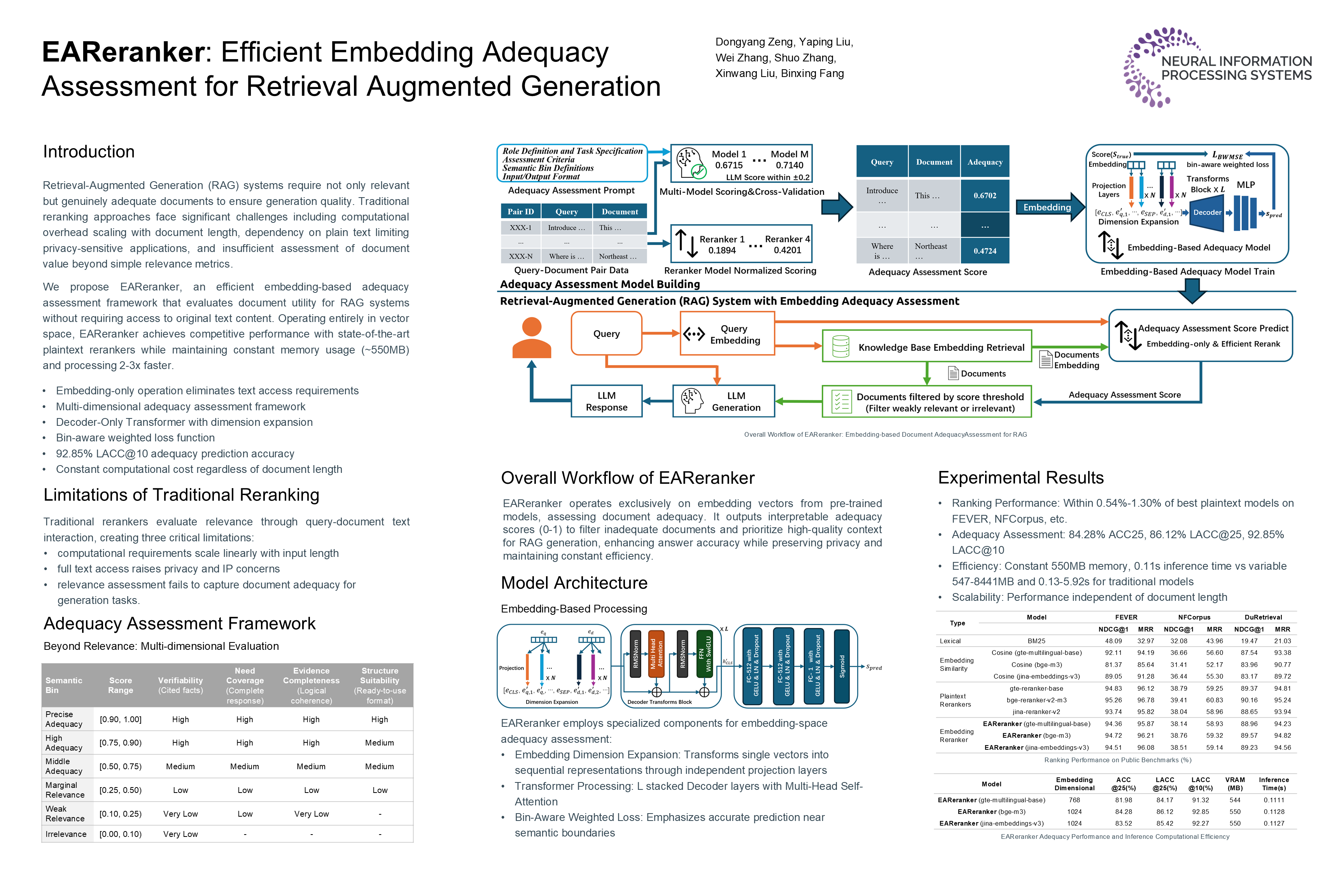
With the increasing adoption of Retrieval-Augmented Generation (RAG) systems for knowledge-intensive tasks, ensuring the adequacy of retrieved documents has become critically important for generation quality. Traditional reranking approaches face three significant challenges: substantial computational overhead that scales with document length, dependency on plain text that limits application in sensitive scenarios, and insufficient assessment of document value beyond simple relevance metrics. We propose EAReranker, an efficient embedding-based adequacy assessment framework that evaluates document utility for RAG systems without requiring access to original text content. The framework quantifies document adequacy through a comprehensive scoring methodology considering verifiability, coverage, completeness and structural aspects, providing interpretable adequacy classifications for downstream applications. EAReranker employs a Decoder-Only Transformer architecture that introduces embedding dimension expansion method and bin-aware weighted loss, designed specifically to predict adequacy directly from embedding vectors. Our comprehensive evaluation across four public benchmarks demonstrates that EAReranker achieves competitive performance with state-of-the-art plaintext rerankers while maintaining constant memory usage ($\sim$550MB) regardless of input length and processing 2-3x faster than traditional approaches. The semantic bin adequacy prediction accuracy of 92.85\% LACC@10 and 86.12\% LACC@25 demonstrates its capability to effectively filter out inadequate documents that could potentially mislead or adversely impact RAG system performance, thereby ensuring only high-utility information serves as generation context. These results establish EAReranker as an efficient and practical solution for enhancing RAG system performance through improved context selection while addressing the computational and privacy challenges of existing methods.
GraphKeeper: Graph Domain-Incremental Learning via Knowledge Disentanglement and Preservation
Zihao Guo ⋅ Qingyun Sun ⋅ Ziwei Zhang ⋅ Haonan Yuan ⋅ HUIPING ZHUANG ⋅ Xingcheng Fu ⋅ Jianxin Li
Graph incremental learning (GIL), which continuously updates graph models by sequential knowledge acquisition, has garnered significant interest recently. However, existing GIL approaches focus on task-incremental and class-incremental scenarios within a single domain. Graph domain-incremental learning (Domain-IL), aiming at updating models across multiple graph domains, has become critical with the development of graph foundation models (GFMs), but remains unexplored in the literature. In this paper, we propose Graph Domain-Incremental Learning via Knowledge Disentanglement and Preservation (GraphKeeper), to address catastrophic forgetting in Domain-IL scenario from the perspectives of embedding shifts and decision boundary deviations. Specifically, to prevent embedding shifts and confusion across incremental graph domains, we first propose the domain-specific parameter-efficient fine-tuning together with intra- and inter-domain disentanglement objectives. Consequently, to maintain a stable decision boundary, we introduce deviation-free knowledge preservation to continuously fit incremental domains. Additionally, for graphs with unobservable domains, we perform domain-aware distribution discrimination to obtain precise embeddings. Extensive experiments demonstrate the proposed GraphKeeper achieves state-of-the-art results with 6.5%\~16.6% improvement over the runner-up with negligible forgetting. Moreover, we show GraphKeeper can be seamlessly integrated with various representative GFMs, highlighting its broad applicative potential.
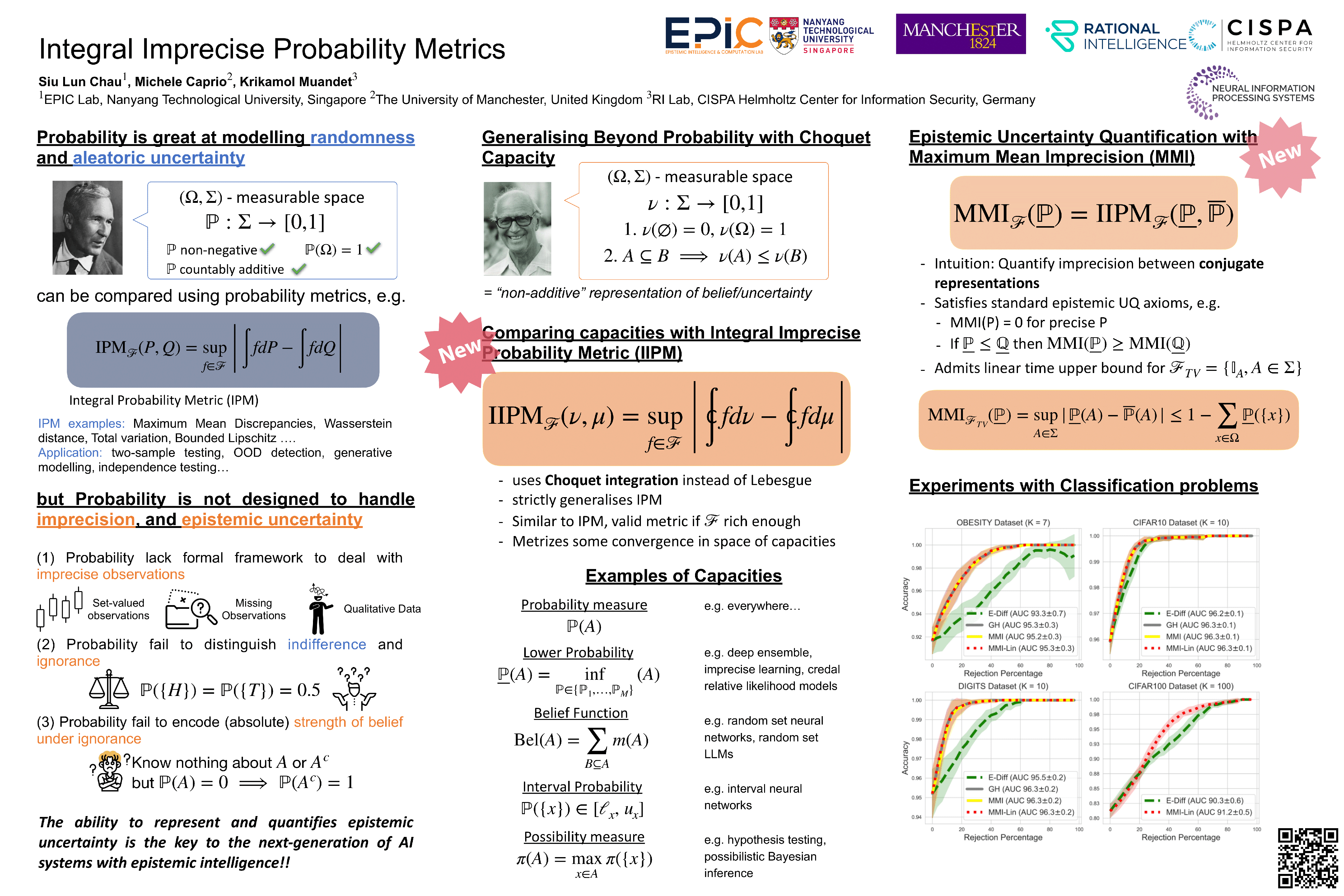
Quantifying differences between probability distributions is fundamental to statistics and machine learning, primarily for comparing statistical uncertainty. In contrast, epistemic uncertainty---due to incomplete knowledge---requires richer representations than those offered by classical probability. Imprecise probability (IP) theory offers such models, capturing ambiguity and partial belief. This has driven growing interest in imprecise probabilistic machine learning (IPML), where inference and decision-making rely on broader uncertainty models---highlighting the need for metrics beyond classical probability. This work introduces the Integral Imprecise Probability Metric (IIPM) framework, a Choquet integral-based generalisation of classical Integral Probability Metric to the setting of capacities---a broad class of IP models encompassing many existing ones, including lower probabilities, probability intervals, belief functions, and more. Theoretically, we establish conditions under which IIPM serves as a valid metric and metrises a form of weak convergence of capacities. Practically, IIPM not only enables comparison across different IP models but also supports the quantification of epistemic uncertainty~(EU) within a single IP model. In particular, by comparing an IP model with its conjugate, IIPM gives rise to a new class of epistemic uncertainty measures---Maximum Mean Imprecision (MMI) ---which satisfy key axiomatic properties proposed in the Uncertainty Quantification literature. We validate MMI through selective classification experiments, demonstrating strong empirical performance against established EU measures, and outperforming them when classical methods struggle to scale to a large number of classes. Our work advances both theory and practice in Imprecise Probabilistic Machine Learning, offering a principled framework for comparing and quantifying epistemic uncertainty under imprecision.
Linguini: A benchmark for language-agnostic linguistic reasoning
Eduardo Sánchez ⋅ Belen Alastruey ⋅ Christophe Ropers ⋅ Arina Turkatenko ⋅ Pontus Lars Erik Saito Stenetorp ⋅ Mikel Artetxe ⋅ Marta Ruiz Costa-jussà
We propose a new benchmark to measure a language model's linguistic reasoning skills without relying on pre-existing language-specific knowledge. The test covers 894 questions grouped in 160 problems across 75 (mostly) extremely low-resource languages, extracted from the International Linguistic Olympiad corpus. To attain high accuracy on this benchmark, models don't need previous knowledge of the tested language, as all the information needed to solve the linguistic puzzle is presented in the context. We find that, while all analyzed models rank below 25% accuracy, there is a significant gap between open and closed models, with the best-performing proprietary model scoring 24.05% and the best-performing open model 8.84%.
More Than Just Functional: LLM-as-a-Critique for Efficient Code Generation
Derui Zhu ⋅ Dingfan Chen ⋅ jinfu chen ⋅ Jens Grossklags ⋅ Alexander Pretschner ⋅ Weiyi Shang
Large language models (LLMs) have demonstrated remarkable progress in generating functional code, leading to numerous AI-based coding program tools. However, their reliance on the perplexity objective during both training and inference primarily emphasizes functionality, often at the expense of efficiency—an essential consideration for real-world coding tasks. Perhaps interestingly, we observed that well-trained LLMs inherently possess knowledge about code efficiency, but this potential remains underutilized with standard decoding approaches. To address this, we design strategic prompts to activate the model’s embedded efficiency understanding, effectively using LLMs as \textit{efficiency critiques} to guide code generation toward higher efficiency without sacrificing—and sometimes even improving—functionality, all without the need for costly real code execution. Extensive experiments on benchmark datasets (EffiBench, HumanEval+) across multiple representative code models demonstrate up to a 70.6\% reduction in average execution time and a 13.6\% decrease in maximum memory usage, highlighting the computational efficiency and practicality of our approach compared to existing alternatives.
OCRBench v2: An Improved Benchmark for Evaluating Large Multimodal Models on Visual Text Localization and Reasoning
Ling Fu ⋅ Zhebin Kuang ⋅ Jiajun Song ⋅ Mingxin Huang ⋅ Biao Yang ⋅ Yuzhe Li ⋅ Linghao Zhu ⋅ Qidi Luo ⋅ Xinyu Wang ⋅ Hao Lu ⋅ Zhang Li ⋅ Guozhi Tang ⋅ Bin Shan ⋅ Chunhui Lin ⋅ Qi Liu ⋅ Binghong Wu ⋅ Hao Feng ⋅ Hao Liu ⋅ Can Huang ⋅ Jingqun Tang ⋅ Wei Chen ⋅ Lianwen Jin ⋅ Yuliang Liu ⋅ Xiang Bai
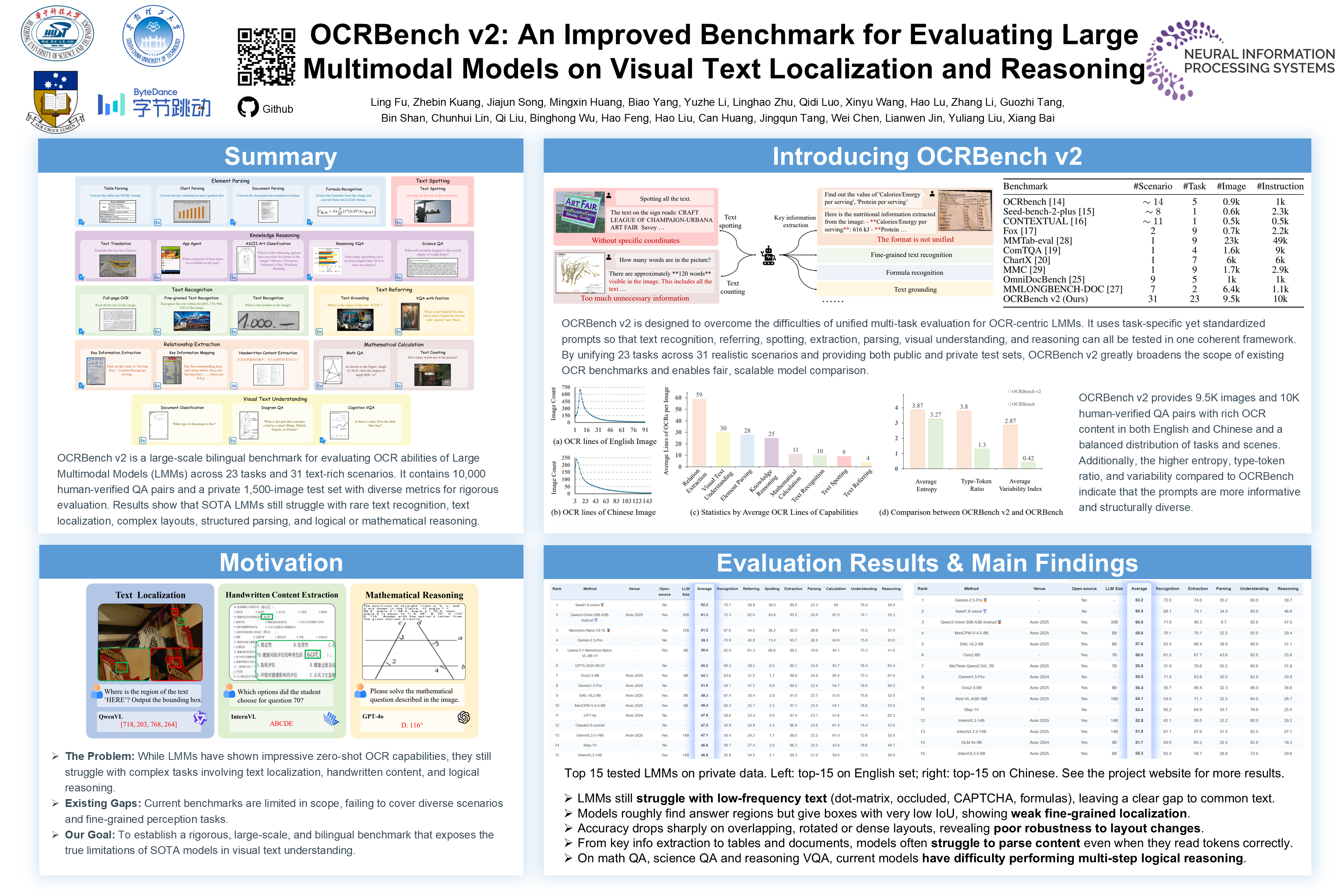
Scoring the Optical Character Recognition (OCR) capabilities of Large Multimodal Models (LMMs) has witnessed growing interest. Existing benchmarks have highlighted the impressive performance of LMMs in text recognition; however, their abilities in certain challenging tasks, such as text localization, handwritten content extraction, and logical reasoning, remain underexplored. To bridge this gap, we introduce OCRBench v2, a large-scale bilingual text-centric benchmark with currently the most comprehensive set of tasks ($4\times$ more tasks than the previous multi-scene benchmark OCRBench), the widest coverage of scenarios ($31$ diverse scenarios), and thorough evaluation metrics, with $10,000$ human-verified question-answering pairs and a high proportion of difficult samples. Moreover, we construct a private test set with $1,500$ manually annotated images. The consistent evaluation trends observed across both public and private test sets validate the OCRBench v2's reliability. After carefully benchmarking state-of-the-art LMMs, we find that most LMMs score below $50$ ($100$ in total) and suffer from five-type limitations, including less frequently encountered text recognition, fine-grained perception, layout perception, complex element parsing, and logical reasoning. The benchmark and evaluation scripts are available at https://github.com/Yuliang-Liu/MultimodalOCR.
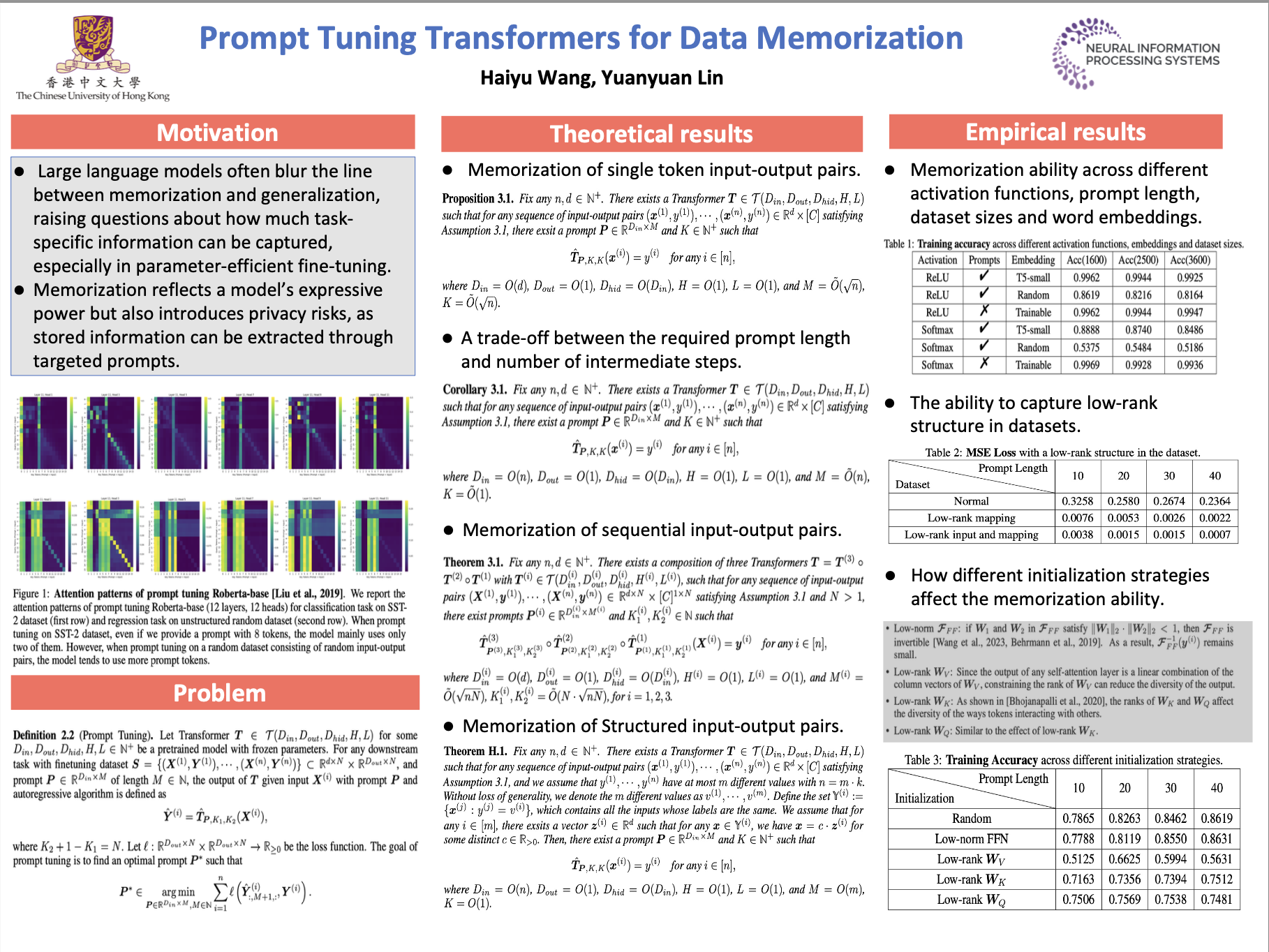
Prompt tuning has emerged as a powerful parameter-efficient fine-tuning technique, allowing large pretrained Transformers to adapt to downstream tasks by optimizing a small set of prompt embeddings. Despite its empirical success, the extent to which prompt tuning can memorize data remains poorly understood. In this paper, we provide both theoretical and empirical analyses of data memorization ability of prompt-tuned Transformers. Building on recent theoretical frameworks, we derive an upper bound on the required prompt length for exact memorization of finite datasets and establish a trade-off between prompt length and the number of autoregressive generation steps. Specifically, we show that a constant-size Transformer can memorize $n$ input-output pairs with prompts of length $\tilde{O}(\sqrt{nN})$, where $N$ denotes the sequence length. Empirical results further demonstrate that prompt-tuned, randomly initialized Transformers are able to effectively memorize finite datasets. These models also capture the intrinsic low-rank structure of the data, leading to a reduction in the required prompt length. Finally, we analyze how the initialization of the Transformer backbone affects the performance of prompt tuning. Our findings provide new insights into the expressivity, efficiency, and underlying mechanisms of prompt tuning, bridging theoretical memorization limits with observed empirical behaviors.
RankSEG-RMA: An Efficient Segmentation Algorithm via Reciprocal Moment Approximation
Zixun Wang ⋅ Ben Dai
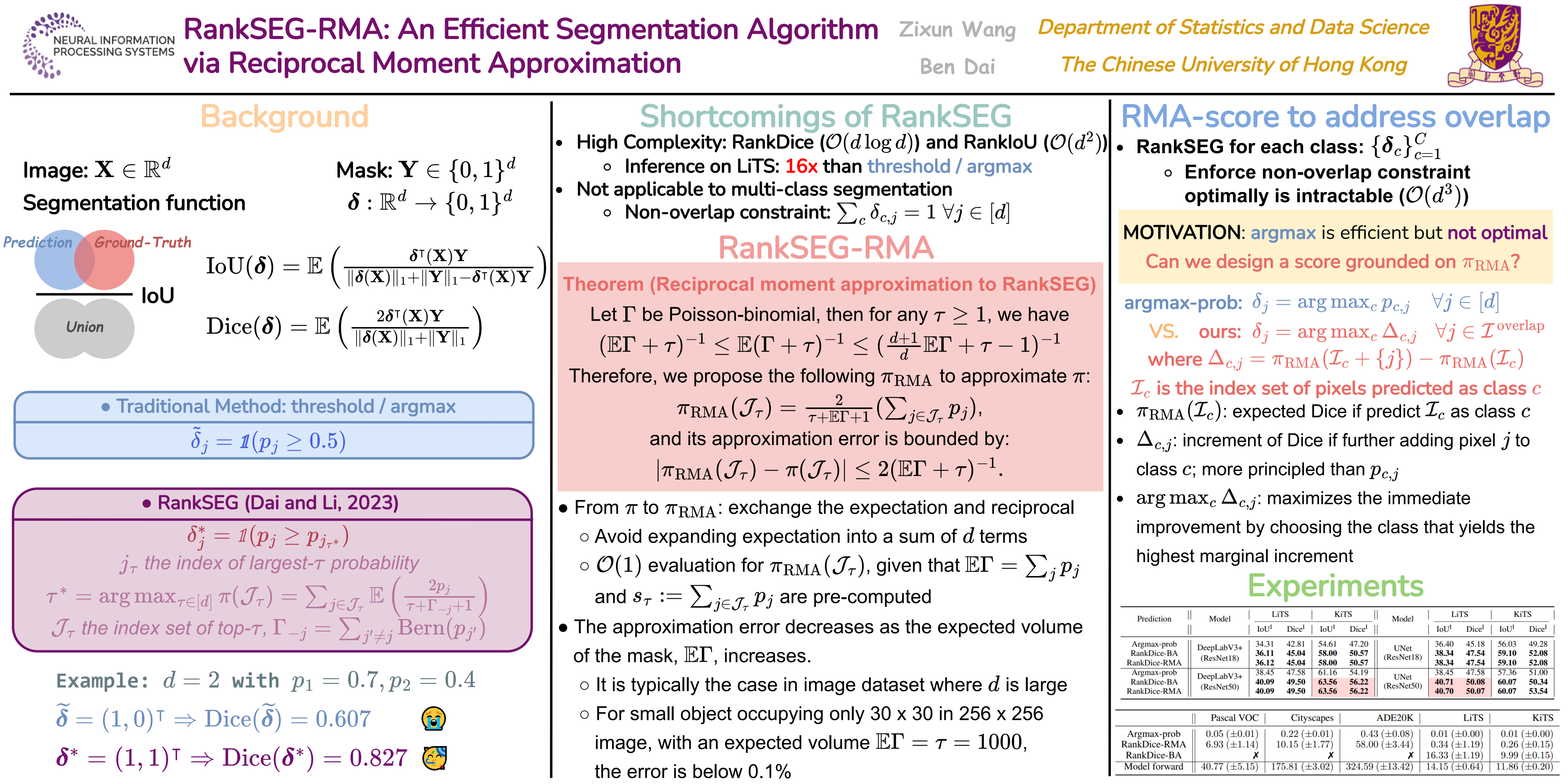
Semantic segmentation labels each pixel in an image with its corresponding class, and is typically evaluated using the Intersection over Union (IoU) and Dice metrics to quantify the overlap between predicted and ground-truth segmentation masks. In the literature, most existing methods estimate pixel-wise class probabilities, then apply argmax or thresholding to obtain the final prediction. These methods have been shown to generally lead to inconsistent or suboptimal results, as they do not directly maximize segmentation metrics. To address this issue, a novel consistent segmentation framework, RankSEG, has been proposed, which includes RankDice and RankIoU specifically designed to optimize the Dice and IoU metrics, respectively. Although RankSEG almost guarantees improved performance, it suffers from two major drawbacks. First, it is its computational expense—RankDice has a complexity of $\mathcal{O}(d \log d)$ with a substantial constant factor (where $d$ represents the number of pixels), while RankIoU exhibits even higher complexity $\mathcal{O}(d^2)$, thus limiting its practical application. For instance, in LiTS, prediction with RankSEG takes 16.33 seconds compared to just 0.01 seconds with the argmax rule. Second, RankSEG is only applicable to overlapping segmentation settings, where multiple classes can occupy the same pixel, which contrasts with standard benchmarks that typically assume non-overlapping segmentation. In this paper, we overcome these two drawbacks via a \textit{reciprocal moment approximation} (RMA) of RankSEG with the following contributions: (i) we improve RankSEG using RMA, namely RankSEG-RMA, reduces the complexity of both algorithms to $\mathcal{O}(d)$ while maintaining comparable performance; (ii) inspired by RMA, we develop a pixel-wise score function that allows efficient implementation for non-overlapping segmentation settings. We illustrate the effectiveness of our method across various datasets and state-of-the-art models. The code of our method is available in: \url{https://github.com/ZixunWang/RankSEG-RMA}.
Semi-supervised Graph Anomaly Detection via Robust Homophily Learning
GUOGUO AI ⋅ Hezhe Qiao ⋅ Hui Yan ⋅ Guansong Pang
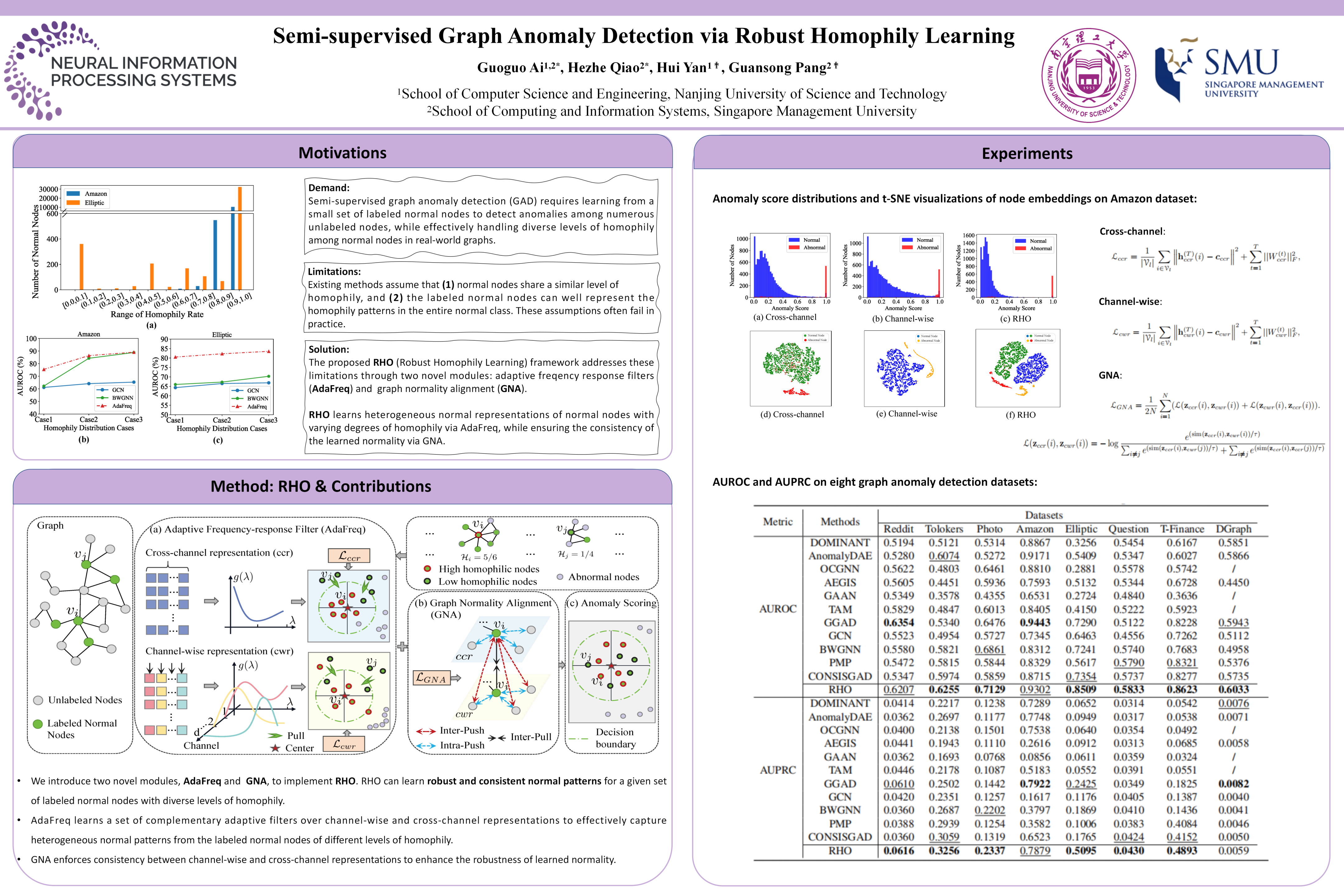
Current semi-supervised graph anomaly detection (GAD) methods utilizes a small set of labeled normal nodes to identify abnormal nodes from a large set of unlabeled nodes in a graph. These methods posit that 1) normal nodes share a similar level of homophily and 2) the labeled normal nodes can well represent the homophily patterns in the entire normal class. However, this assumption often does not hold well since normal nodes in a graph can exhibit diverse homophily in real-world GAD datasets. In this paper, we propose RHO, namely Robust Homophily Learning, to adaptively learn such homophily patterns. RHO consists of two novel modules, adaptive frequency response filters (AdaFreq) and graph normality alignment (GNA). AdaFreq learns a set of adaptive spectral filters that capture different frequency components of the labeled normal nodes with varying homophily in the channel-wise and cross-channel views of node attributes. GNA is introduced to enforce consistency between the channel-wise and cross-channel homophily representations to robustify the normality learned by the filters in the two views. Experiments on eight real-world GAD datasets show that RHO can effectively learn varying, often under-represented, homophily in the small labeled node set and substantially outperforms state-of-the-art competing methods. Code is available at \url{https://github.com/mala-lab/RHO}.
SEMPO: Lightweight Foundation Models for Time Series Forecasting
Hui He ⋅ Kun Yi ⋅ Yuanchi Ma ⋅ Qi Zhang ⋅ Zhendong Niu ⋅ Guansong Pang
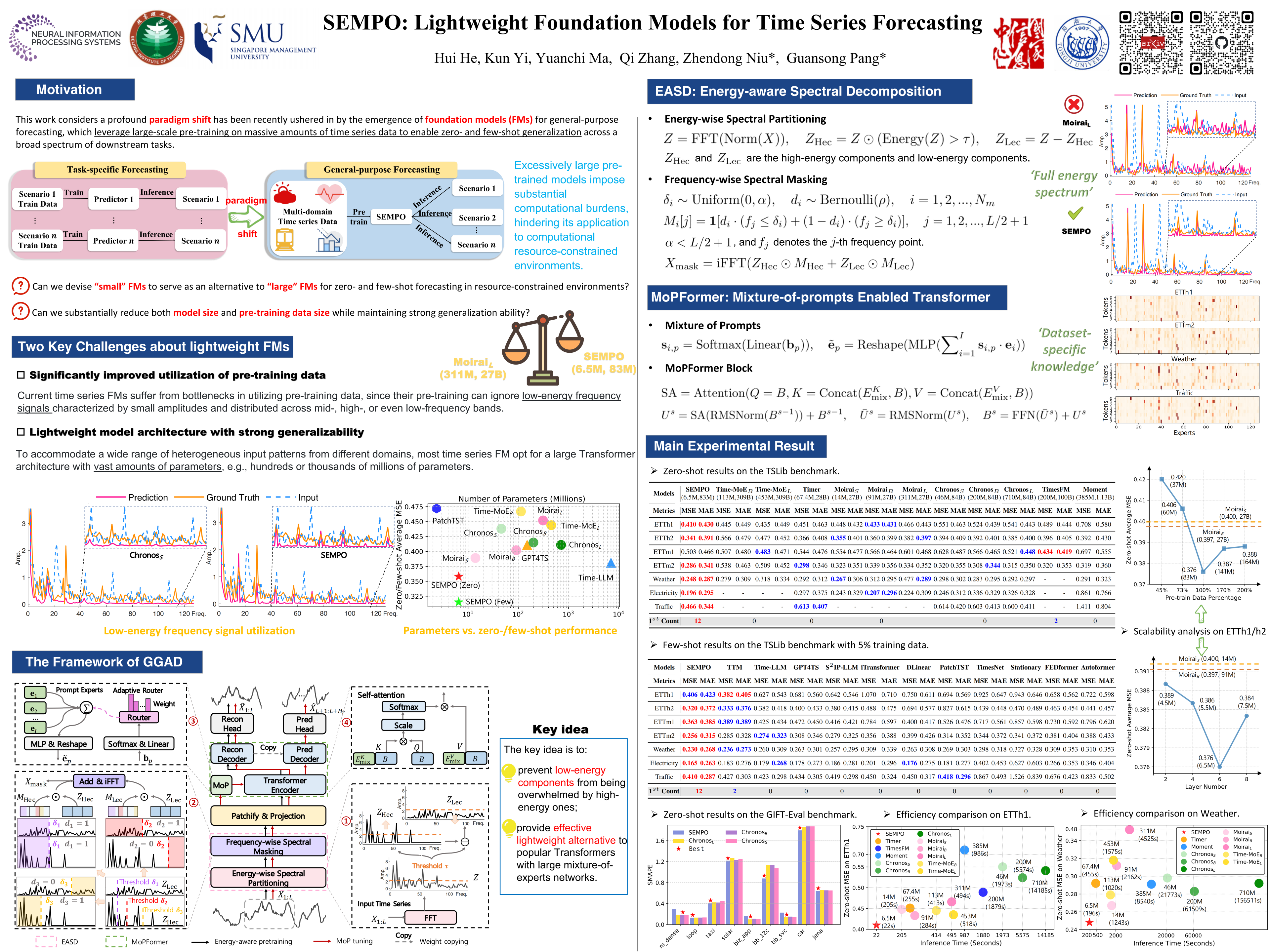
The recent boom of large pre-trained models witnesses remarkable success in developing foundation models (FMs) for time series forecasting. Despite impressive performance across diverse downstream forecasting tasks, existing time series FMs possess massive network architectures and require substantial pre-training on large-scale datasets, which significantly hinders their deployment in resource-constrained environments. In response to this growing tension between versatility and affordability, we propose SEMPO, a novel lightweight foundation model that requires pretraining on relatively small-scale data, yet exhibits strong general time series forecasting. Concretely, SEMPO comprises two key modules: 1) energy-aware SpEctral decomposition module, that substantially improves the utilization of pre-training data by modeling not only the high-energy frequency signals but also the low-energy yet informative frequency signals that are ignored in current methods; and 2) Mixture-of-PrOmpts enabled Transformer, that learns heterogeneous temporal patterns through small dataset-specific prompts and adaptively routes time series tokens to prompt-based experts for parameter-efficient model adaptation across different datasets and domains. Equipped with these modules, SEMPO significantly reduces both pre-training data scale and model size, while achieving strong generalization. Extensive experiments on two large-scale benchmarks covering 16 datasets demonstrate the superior performance of SEMPO in both zero-shot and few-shot forecasting scenarios compared with state-of-the-art methods. Code and data are available at https://github.com/mala-lab/SEMPO.
Storyboard-guided Alignment for Fine-grained Video Action Recognition
Enqi Liu ⋅ Liyuan Pan ⋅ Yan Yang ⋅ Yiran Zhong ⋅ Zhijing Wu ⋅ Xinxiao Wu ⋅ Liu Liu
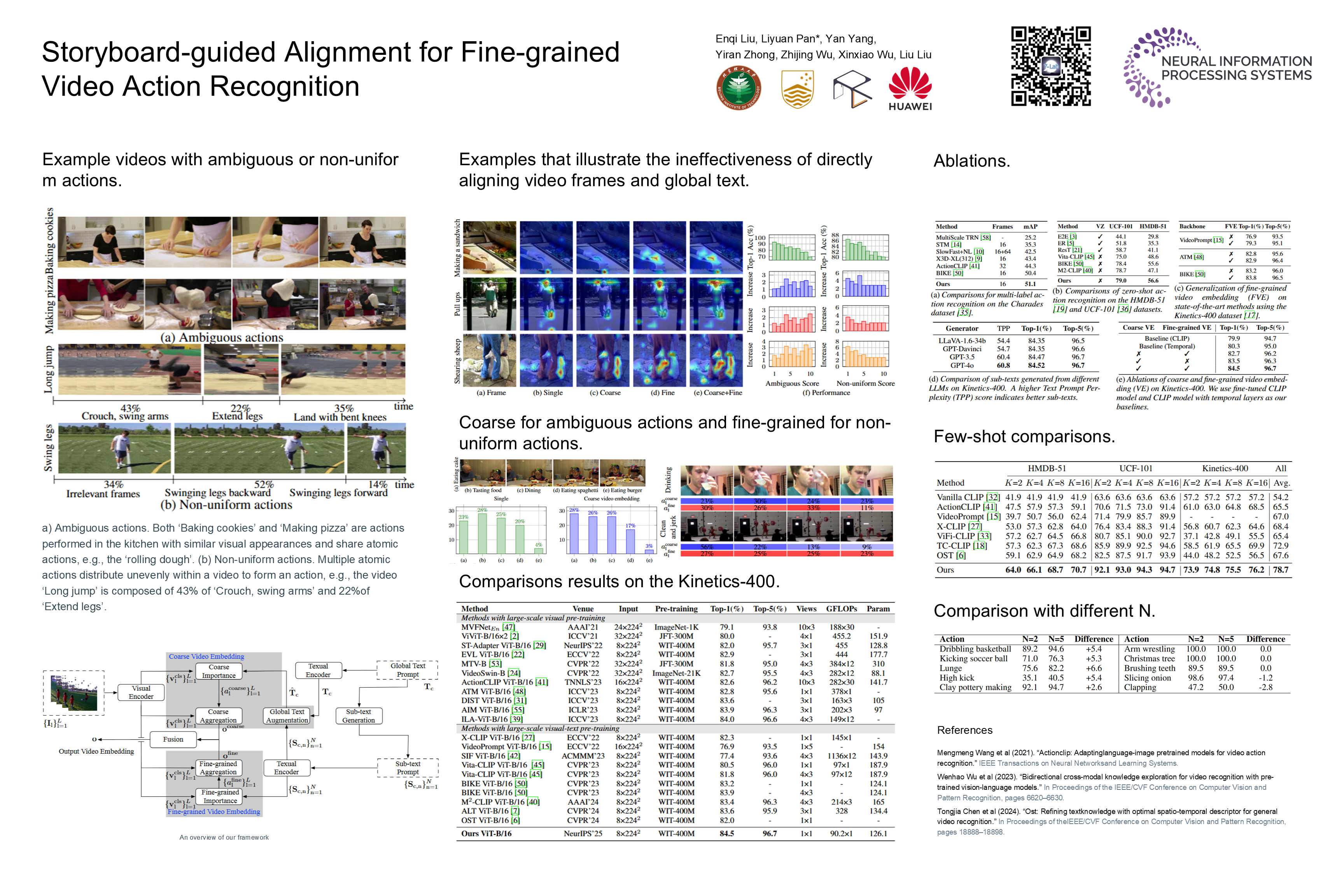
Fine-grained video action recognition can be formulated as a video–text matching problem. Previous approaches primarily rely on global video semantics to consolidate video embeddings, often leading to misaligned video–text pairs due to inaccurate atomic-level action understanding. This inaccuracy arises due to i) videos with distinct global semantics may share similar atomic actions or visual appearances, and ii) atomic actions can be momentary, gradual, or not directly aligned with overarching video semantics. Inspired by storyboarding, where a script is segmented into individual shots, we propose a multi-granularity framework, SFAR. SFAR generates fine-grained descriptions of common atomic actions for each global semantic using a large language model. Unlike existing works that refine global semantics with auxiliary video frames, SFAR introduces a filtering metric to ensure correspondence between the descriptions and the global semantics, eliminating the need for direct video involvement and thereby enabling more nuanced recognition of subtle actions. By leveraging both global semantics and fine-grained descriptions, our SFAR effectively identifies prominent frames within videos, thereby improving the accuracy of embedding aggregation. Extensive experiments on various video action recognition datasets demonstrate the competitive performance of our SFAR in supervised, few-shot, and zero-shot settings.
The Quotient Bayesian Learning Rule
Mykola Lukashchuk ⋅ Raphaël Trésor ⋅ Wouter Nuijten ⋅ Ismail Senoz ⋅ Bert Vries
This paper introduces the Quotient Bayesian Learning Rule, an extension of natural-gradient Bayesian updates to probability models that fall outside the exponential family. Building on the observation that many heavy-tailed and otherwise non-exponential distributions arise as marginals of minimal exponential families, we prove that such marginals inherit a unique Fisher–Rao information geometry via the quotient-manifold construction. Exploiting this geometry, we derive the Quotient Natural Gradient algorithm, which takes steepest-descent steps in the well-structured covering space, thereby guaranteeing parameterization-invariant optimization in the target space. Empirical results on the Student-$t$ distribution confirm that our method converges more rapidly and attains higher-quality solutions than previous variants of the Bayesian Learning Rule. These findings position quotient geometry as a unifying tool for efficient and principled inference across a broad class of latent-variable models.
Turning the Tables: Enabling Backward Transfer via Causal-Aware LoRA in Continual Learning
Chaoyang Li ⋅ Runze Ye ⋅ Jianyang Qin ⋅ Jinhao Cui ⋅ Lingzhi Wang ⋅ Ning Hu ⋅ Qing Liao
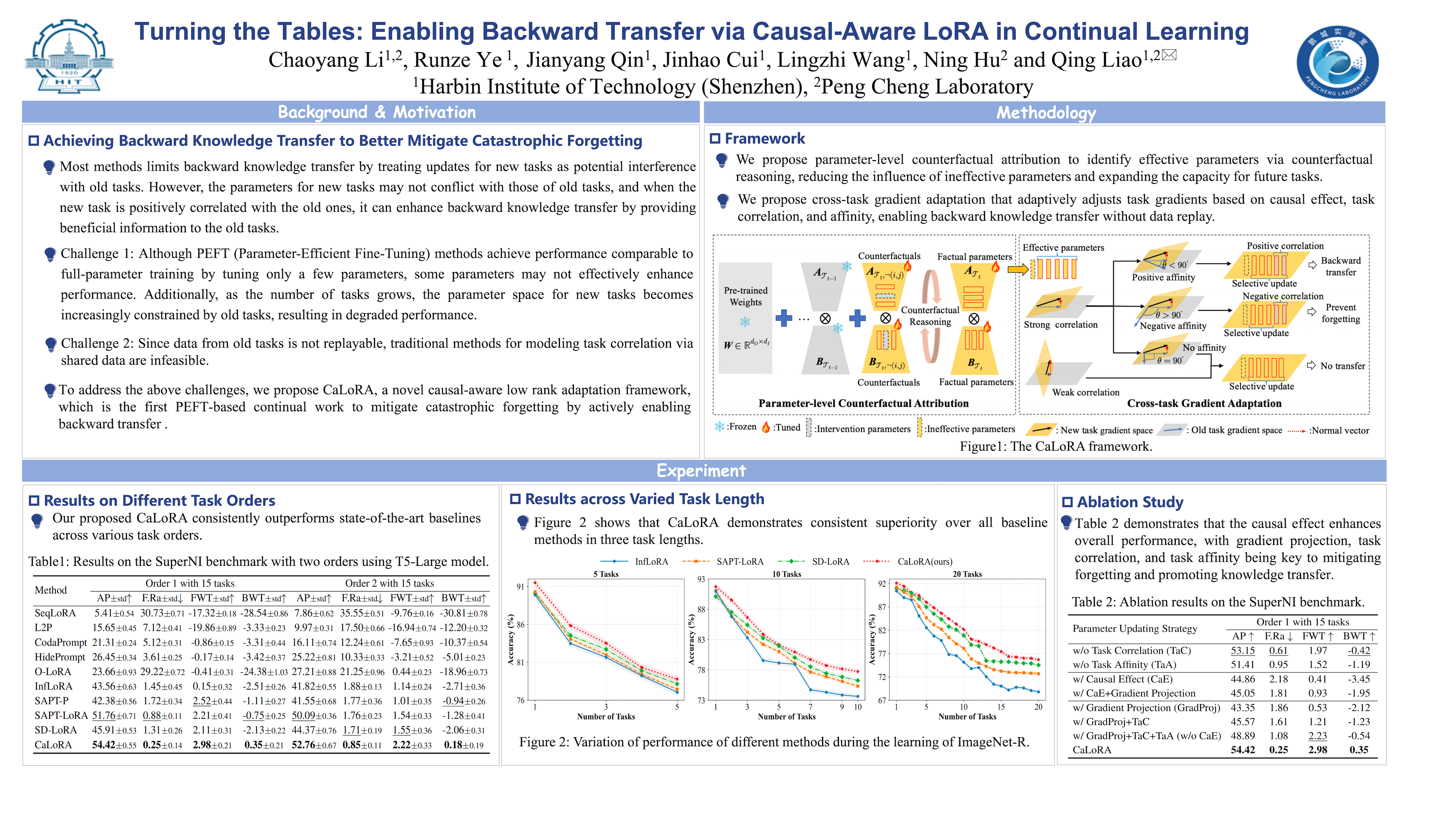
Current parameter-efficient fine-tuning (PEFT) methods have shown superior performance in continual learning. However, most existing PEFT-based methods focus on mitigating catastrophic forgetting by limiting modifications to the old task model caused by new tasks. This hinders backward knowledge transfer, as when new tasks have a strong positive correlation with old tasks, appropriately training on new tasks can transfer beneficial knowledge to old tasks. Critically, achieving backward knowledge transfer faces two fundamental challenges: (1) some parameters may be ineffective on task performance, which constrains the task solution space and model capacity; (2) since old task data are inaccessible, modeling task correlation via shared data is infeasible. To address these challenges, we propose CaLoRA, a novel \textbf{c}ausal-\textbf{a}ware \textbf{lo}w-\textbf{r}ank \textbf{a}daptation framework that is the first PEFT-based continual learning work with backward knowledge transfer. Specifically, we first propose \textbf{p}ar\textbf{a}meter-level \textbf{c}ounterfactual \textbf{a}ttribution (PaCA) that estimates the causal effect of LoRA parameters via counterfactual reasoning, identifying effective parameters from a causal view. Second, we propose \textbf{c}ross-t\textbf{a}sk \textbf{g}radient \textbf{a}daptation (CaGA) to quantify task correlation by gradient projection and evaluate task affinity based on gradient similarity. By incorporating causal effect, task correlation, and affinity, CaGA adaptively adjusts task gradients, facilitating backward knowledge transfer without relying on data replay. Extensive experiments across multiple benchmarks and continual learning settings show that CaLoRA outperforms state-of-the-art methods. In particular, CaLoRA better mitigates catastrophic forgetting by enabling positive backward knowledge transfer.
UFO-RL: Uncertainty-Focused Optimization for Efficient Reinforcement Learning Data Selection
Yang Zhao ⋅ Kai Xiong ⋅ Xiao Ding ⋅ Li Du ⋅ Yangou Ouyang ⋅ Zhouhao Sun ⋅ Jiannan Guan ⋅ Wenbin Zhang ⋅ Bin Liu ⋅ Dong Hu ⋅ Bing Qin ⋅ Ting Liu
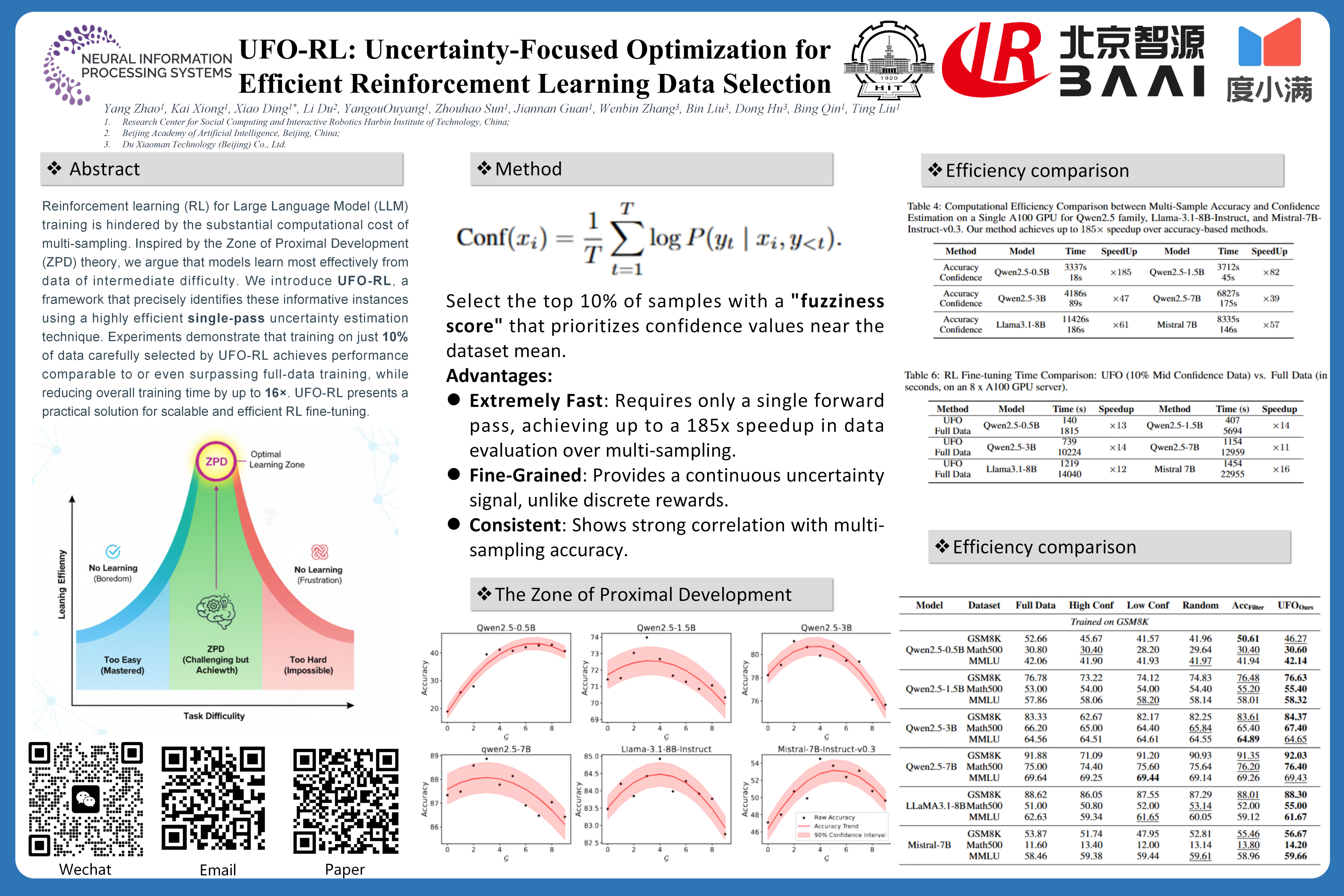
A primary impediment to scaling reinforcement learning (RL) for large language model (LLM) training is the substantial computational cost, predominantly arising from the necessity of multi-sampling for policy optimization and evaluation. This underscores the critical yet challenging nature of efficient training data selection. Drawing inspiration from the Zone of Proximal Development (ZPD) theory, which posits that learners acquire knowledge more effectively from tasks of intermediate difficulty, we hypothesize that LLMs exhibit optimal learning from data they have not yet mastered but demonstrate the potential to comprehend. Conventional methodologies for assessing data difficulty or informativeness typically rely on computationally intensive multi-sampling or iterative procedures. To address this limitation, we introduce UFO-RL (**U**ncertainty-**F**ocused **O**ptimization for **R**einforcement **L**earning), a novel framework that employs a computationally efficient single-pass uncertainty estimation technique to identify informative training instances. This method, requiring only a single forward pass and obviating the need for iterative next-token computation, achieves a significant acceleration (up to 185$\times$) in data evaluation compared to multi-sampling approaches. UFO-RL leverages this efficient metric to select data within the model's estimated ZPD for training. Extensive experimentation across diverse LLMs and mathematical benchmarks demonstrates that training with a mere 10\% of the data, carefully selected by UFO-RL, yields performance comparable to or even surpassing that of full-data training. Furthermore, this targeted data selection results in up to a 16$\times$ reduction in overall training time, concurrently enhancing training stability and improving generalization capabilities. Thus, UFO-RL presents a practical and highly efficient strategy for scaling RL fine-tuning of LLMs by focusing learning efforts on the most informative and valuable data, thereby mitigating the computational bottlenecks associated with traditional RL training.
UniGTE: Unified Graph–Text Encoding for Zero-Shot Generalization across Graph Tasks and Domains
Duo Wang ⋅ Yuan Zuo ⋅ Guangyue Lu ⋅ Junjie Wu
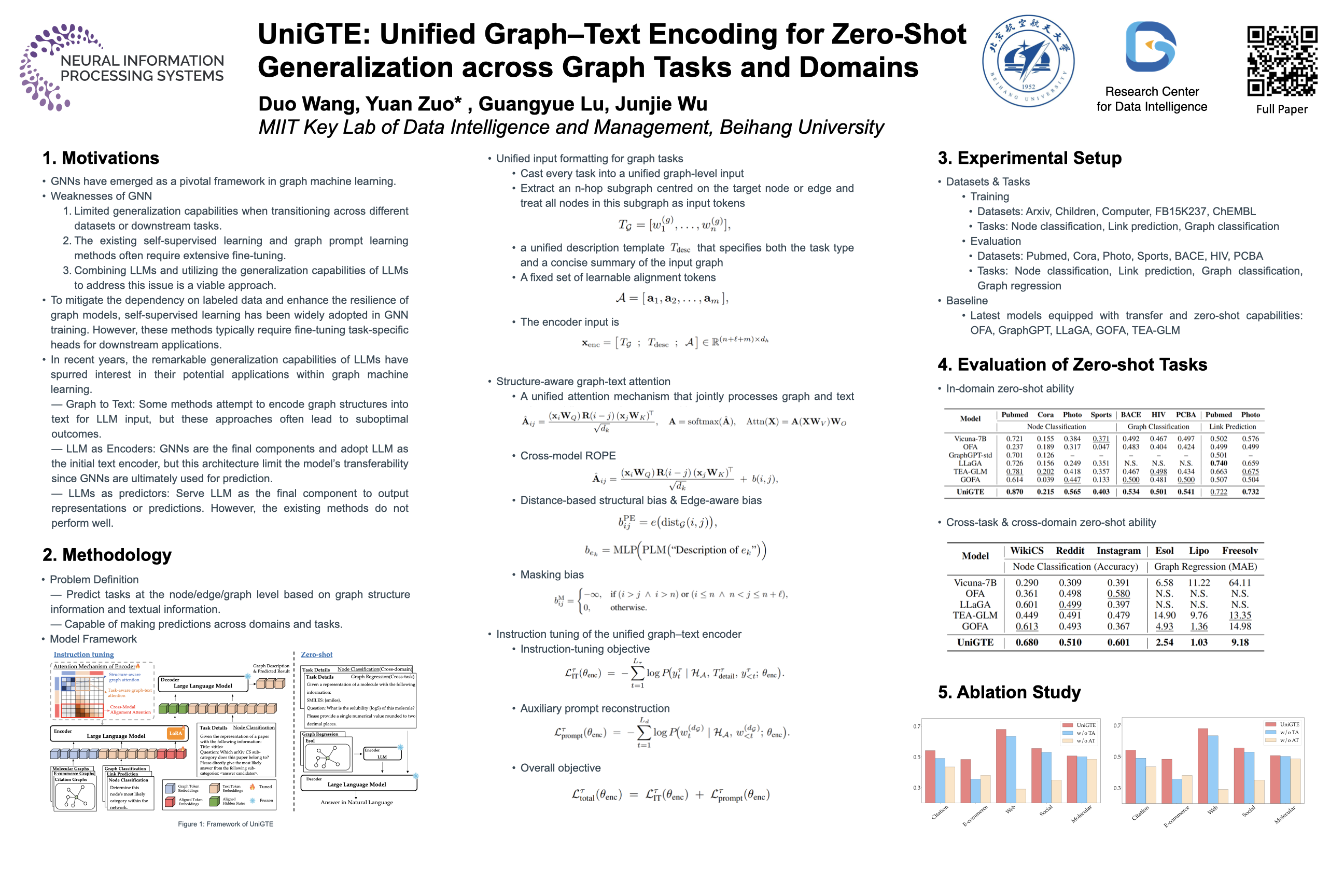
Generalizing to unseen graph tasks without task-specific supervision is challenging: conventional graph neural networks are typically tied to a fixed label space, while large language models (LLMs) struggle to capture graph structure. We introduce UniGTE, an instruction-tuned encoder–decoder framework that unifies structural and semantic reasoning. The encoder augments a pretrained autoregressive LLM with learnable alignment tokens and a structure-aware graph–text attention mechanism, enabling it to attend jointly to a tokenized graph and a natural-language task prompt while remaining permutation-invariant to node order. This yields compact, task-aware graph representations. Conditioned solely on these representations, a frozen LLM decoder predicts and reconstructs: it outputs the task answer and simultaneously paraphrases the input graph in natural language. The reconstruction objective regularizes the encoder to preserve structural cues. UniGTE is instruction-tuned on five datasets spanning node-, edge-, and graph-level tasks across diverse domains, yet requires no fine-tuning at inference. It achieves new state-of-the-art zero-shot results on node classification, link prediction, graph classification and graph regression under cross-task and cross-domain settings, demonstrating that tight integration of graph structure with LLM semantics enables robust, transferable graph reasoning.