
Creative AI
Creative AI Session 2
Yingtao Tian ⋅ Piotr Mirowski ⋅ Immanuel Koh ⋅ Tom White ⋅ Wei-Yao Wang
Bodies in Dialogue: Exploring Perceived Agency through Embodied AI in Human-Robot Theatre
Maleen Jayasuriya ⋅ Piumi Wijesundara ⋅ Gavin Robins ⋅ Marcelo Zavala-Baeza ⋅ Beth Shulman ⋅ Suzanne Osmond ⋅ Damith Herath
Bodies in Dialogue is a process documentary following a practice-as-research workshop led by RAPP Lab (the Robots, Art, People and Performance Laboratory, University of Canberra) with the National Institute of Dramatic Art in Sydney. Traditionally, a robot's movement on stage has been confined to three interaction paradigms (puppeteered control, scripted trajectories and rule-based control), in all of which a human authors the movement in advance or by hand. We order these along a spectrum of perceived agency: the initiative that collaborators and audiences collectively attribute to the machine. The documentary traces the creation and in-the-wild deployment of a fourth paradigm, learned generative interaction, through ENACT, a lightweight vision-action model trained on a physical theatre vocabulary that generates a robot arm's movement in real time from its perception of a co-present performer. Across three days, acting, design and engineering students train alongside the arm through Meyerhold's biomechanics, Bogart's Viewpoints and Lecoq's pedagogy, culminating in three devised works authored by neither performers nor model alone, and a shift in how the ensemble perceives, and creates with, the machine.
Effort returns the trace of a model learning from human dance to the body. The training log becomes both music and a sequence of Laban Effort words. The music conditions the trained model and accompanies a human dancer, while the words guide her improvisation as choreographic prompts. The two movements share a training trace and timeline, but take shape through different forms. As movement passes from bodies into data, through training, and back into bodies, the work asks how agency is distributed across dancers, data, models, and artistic interpretation. Who, or what, is making the dance happen?
Give Me a Hand is a co-cooking performance between the artist and a small creature that lives in a chef's hat. The creature watches the world through a camera module and interacts with its surroundings by controlling the artist's hand through electrical muscle stimulation (EMS). It uses GPT-5.6 as its brain: each camera frame produces a structured thought, which is continuously printed by a thermal printer at the back of the hat, forming a paper trail that remains hidden from the artist throughout the performance. The creature is deliberately given a single physical capability, granted specifically for ingredient selection: it can close the artist's fingers. The creature selects among the ingredients on the table with a hidden recipe in mind, planning what it would cook. When the artist's hand comes near an ingredient it wants, her fingers close around it. Once the selection is complete, the cooking belongs to the artist. She improvises a dish from whatever the creature has chosen, often diverging from its hidden agenda. The creature continues watching and occasionally tries to intervene through the same limited gesture. Only once the cooking is over can the artist read the printed record and interpret what the creature had intended and the influence it had tried to exert during the performance. The piece asks what it means to lend a machine one small part of your body and what it can, and cannot, do with it.
The glitch is the only certainty. In this acknowledgment of failure, shaped by social constructs that surround our embodied forms, we strive for metamorphosis. What if we could plunge into the mirror between you and me, the viewer and the performer? ``For my body, then, subversion came via digital remix, searching for those sites of experimentation where I could explore my true self, open and ready to be read.'' (glitch-ing bodies - Legacy Russel) Through a thoroughly designed process, a dancer claims their own appearance: from choosing self-defined forms, materials and textures to slipping into AI-assisted versions of themselves. The range of this project spans from contemporary dance to fully synthesized choreography and imaging.
Human Operator
Peter He ⋅ Sean Hardesty Lewis ⋅ Valdemar Danry ⋅ Yutong Wu ⋅ Daniel Kaijzer ⋅ Ashley Neall
Human Operator lets a wearer delegate the execution of an intended action to an AI system. The wearer makes an open-ended request while a vision-language model observes the scene from their point of view. Rather than returning an instruction, the model interprets the visible context and selects movements that are enacted through the wearer’s muscles using electrical muscle stimulation (EMS). Its choices are limited to movements calibrated in advance for the wearer. The wearer decides whether the interaction continues, but does not specify each movement as it occurs.
What would a musician choose to play in a room that does not exist? From vast cathedrals to intimate recording studios, musicians readily adapt their performances to the acoustic spaces that surround them. In the absence of real reverberant spaces, musicians often turn to digital simulations---which typically simulate either specific real-world spaces or physically-plausible spaces. However, generative data-driven AI and machine learning systems can be used to create not only in-distribution examples that resemble the real world, but also out-of-distribution examples that depart from physical constraints. In this work, we train a fixed-topology feedback delay network (FDN) model on a corpus of real-world room impulse responses, and explore the periphery of the resulting latent space to generate a variety of physically implausible or impossible acoustic spaces. We use the system in a live musical performance where we create an improvised composition in real-time while immersed in a simulated ``impossible acoustic space.'' We present this work as a case study for how AI systems can expand artistic practice by altering the conditions of creation: introducing unfamiliar contexts that invite new forms of musical response while preserving artistic agency.
Inner Witness is a closed-loop neuroadaptive audiovisual installation and creative brain-computer interface that makes the otherwise fixed boundaries of a generative system perceptible by changing them while a viewer is inside it. It asks how a system that reinforces, opposes, or narrates a viewer’s affect redistributes agency and authorship among the viewer, generative system, and composer. A single viewer wearing a four-channel EEG headband sits before three screens of emotion-annotated film; measures derived from their EEG drive parameters across three music models: Lyria RealTime, Magenta RealTime 2, and RAVE. The music they hear is composed as they watch. Over one sitting, three undisclosed stances — Alignment, Adversarial and Composed — carry that viewer from contributing without knowing it, to steering the work deliberately, to having that steering resisted, and back to contributing without control.
In the Mix: AI Support for Live DJ Track Selection
Joseph Daher ⋅ Eric Chen ⋅ Mingchen Ma ⋅ Cynthia Rudin ⋅ Yue Jiang ⋅ Stephen Ni-Hahn
Disc jockeys (DJs) play a central role in shaping dance-floor experiences. To achieve their overall goals for their set, DJs solve a difficult optimization problem each time they choose a song. They consider local song compatibility, involving genre, tempo, harmonic alignment, and groove, with the desired energy and direction of the set in response to the crowd. We present a framework, OptiMix, with an interactive visual tool that allows the DJ to formulate and solve this optimization problem during a live set. Our tool allows the DJ to weigh various factors when adjusting custom distance metrics between songs. We introduce a novel dimension reduction algorithm, SmoothMAP, to visualize the songs according to the DJ's distance metric. SmoothMAP is a general algorithm and can be used broadly for problems where we expect smooth changes in dimension reduction plots when smoothly adjusting the weights within the distance metric. OptiMix allows DJs to think more broadly about their goals for the set and better optimize song choices in accordance with those goals.
In ordinary drawing, seeing and moving form one closed loop inside one person: the eye corrects the hand continuously, and the two are experienced as a single act. This paper presents KAAYA (Kinaesthetic Abstract Art through Yaw and Attitude), a system that deliberately cuts that loop and gives each half to a different agent. A blindfolded artist keeps the motor half: an inertial measurement unit on the back of the hand turns the orientation of the body into paint, and nothing else reaches the canvas. A machine takes the visual half: it sees every curve the artist can never see, and interprets the accumulated trace into a finished artwork. Kaaya is the Sanskrit word for the body, and the body is the only instrument the artist is permitted. A first version of the system is built and runs end to end on an Arduino Nano 33 IoT streaming into a Unity canvas and a generative image model. This paper reports that instrument, argues that blind drawing is the limit case of a finding from our earlier work, namely that the kinematics of drawing carry more of its identity than its appearance, and specifies a second version with four extensions: a kinematic expressiveness channel, a symmetric double blindness in which the machine can also be kept blind to the artist's intention, a two regime dial that makes the delegation of interpretive agency adjustable, and a reveal ritual that places the artist's belief, the body's trace, and the machine's interpretation side by side. Authorship here is split not between human idea and machine execution but down the middle of the sensorimotor loop itself, and the paper examines what that split does to creative agency.
Light Language Objects: Ambiguity and Otherness in Embodied AI
Lilith Yu ⋅ Quincy Kuang ⋅ Awu Chen ⋅ Paul-Peter ARSLAN ⋅ Marcelo Coelho
When AI talks like a person, people tend to treat it like one. Large language models match our language, tone, and emotional cues, which can make a hollow or inappropriate response feel personal. Most systems address this problem by making the model more humanlike. Light Language Objects explore another direction: what kinds of relationships become possible when AI is allowed to remain perceptibly other? We present Light Language Objects (LLOs), three embodied AI artifacts that listen to speech but respond only through color, brightness, rhythm, and movement. Because the model cannot answer in words, its responses remain ambiguous. The person interprets each light gesture and decides whether to save it. Over time, repeated expressions can form a small visual vocabulary whose meanings remain personal and open to change. Meaning is shaped by the model's proposals, the person's interpretations, the software's memory, and the physical limits of each lantern. LLOs examine whether this lower-resolution form of communication can support curiosity and empathic attention while keeping the AI clearly nonhuman.
Lose Yourself: Controlling the Model is an installation that brings together live EEG, Arabic Sufi music, and Islamic geometric patterns. As participants sit with the work, their biosignals influence the colors and movement of the projected image. With time, they may find that stillness and self-regulation help settle the visual system, giving them a sense of control over it. What they do not initially know is that their biosignal data is also being used to train a model that changes what future participants will experience. At the end, the work reveals what was collected and how their session affected the system. They can then choose to preserve their contribution, delete it, or distort it before passing it on. The work asks what control means when an interaction that feels personal also becomes training data.
LumiComposer: Negotiating Creative Control Between Illumination, Mapping, and Generative Music Models
Chi-Hung Huang ⋅ Ting-Kang Wang ⋅
Real-time creative systems redistribute authorship across sensors, mappings, and generative models, yet modern optical standards reduce dynamic ambient light to static metrics such as hex color codes, stripping its temporal and sensory depth. To let people sense light more intuitively, we present LumiComposer, to our knowledge the first real-time spectral-to-music system that steers a streaming generative music model directly from ambient light, deployed on a custom hardware sensing device. The system pairs a continuous mapping from multi-band spectra to music attributes with an LLM-generated micro-poem that mediates between light and sound, forming a dual-path generative architecture. To evaluate this design, we conduct a user study on human preference: participants prefer poetically mediated audio over pure physical sonification $68.5\%$ of the time, with physical mapping grounding low-level acoustic properties and poetic imagery driving the affective congruence behind that preference. These results suggest that creative agency in real-time generative systems is not fixed but negotiated between deterministic physical mapping and generative poetic mediation.
Magic Quill: A Real-time Score Engraving System for Live MIDI Performances
Lynn Ye ⋅ Roger Dannenberg ⋅ Chris Donahue
We present Magic Quill, a browser-based system that visualizes live MIDI performances as an evolving engraved score. An online beat tracker produces provisional notation immediately, while an asynchronous offline model revises earlier measures as additional musical context becomes available. On consumer hardware, the online model requires approximately 0.13 ms per note and browser-based online beat-tracking inference completes within approximately 10 ms; offline refinement arrives after several seconds and achieves competitive transcription accuracy using substantially less context than prior offline systems. A demonstration of our proposed system is available at https://magicquill.github.io.
Passing: An Endless Journey through Reconstructed Spacetime with AI-Generated Sound
Akira Takahashi ⋅ Chihiro Nagashima ⋅ Zhi Zhong ⋅ Shusuke Takahashi ⋅ Yuki Mitsufuji
This paper introduces $\textit{Passing}$, an interactive audiovisual installation that generates an endless journey from a single continuous monorail-window recording by reconstructing it as a spatiotemporal volume. Rather than replaying the footage linearly, the work resamples its spatial and temporal structure along nonlinear trajectories, producing a continuously passing landscape whose depth, speed, and temporal order become unstable. A camera-based viewer-presence detection system estimates whether a viewer is present in the viewing zone and uses this presence state to influence transitions among rendered video sequences. The resulting video stream is fed into SpecMaskFoley, a real-time video-to-audio synthesis model that generates a synchronized soundscape for the reconfigured image. The model is not used to reconstruct an objectively correct soundtrack, but functions as a speculative listener, proposing a possible auditory interpretation of a world whose conventional spatial and temporal premises have been disrupted. $\textit{Passing}$ distributes creative agency across the artist, who defines the rules of spacetime reconstruction; the AI model, which interprets the emergent visual flow as sound; and the audience, whose embodied presence influences the audiovisual trajectory. Through this structure, the work investigates how authorship and listening may be negotiated among human intention, machine inference, and audience interpretation. Artwork page: https://ryufurusawa.com/passing
Preference Without Assertion: Locating Aesthetic Agency in a Gaze-Driven Design System
Sankar Balasubramanian ⋅
This paper reports what happened to creative agency inside a system we built to read it. EUPHORIA--RETINA captures a designer's aesthetic preference from gaze inside an immersive virtual moodspace and hands that signal to an agentic pipeline that generates product form. By its own metrics the system succeeds: it is more than four times faster than manual practice, and fifty independent experts, blind to how each artefact was made, ranked its outputs highest on every problem. This paper is about what that success displaced. Across three studies ($n{=}30$; $n{=}30$; a Latin-square comparison of four workflows judged by 50 experts) we find that a single priming sentence delivered before a session severs the link between gaze duration and preference ($r = {+}0.38 \rightarrow {-}0.09$) while cutting disagreement between observers by 64\%---and that the gaze signal itself is unchanged, so the system cannot tell which regime it is operating in. Through a stage-level authorship ledger we further show that delegating perception to the machine bought almost nothing (${+}0.6$ points of measured design quality) while delegating generation bought almost everything (${+}26.6$). We conclude that in creative systems that read the body rather than ask the person, aesthetic agency migrates to whoever writes the sentence before the session begins.
Not all vibrato is created equal. Singers decide which notes receive more of it, and this decision contributes to phrasing. In VocalSet [1], notes held twice as long as their neighbors have about 16% deeper vibrato, and phrase-final notes have about 17% deeper vibrato. We ask whether a learned vibrato evaluator can detect this placement. To test this, we build WaveMaster, a MERT-based vibrato-presence classifier following the evaluation used in recent singing-synthesis work. Recordings are then edited note by note. Our main modification keeps the same set of vibrato depths but assigns those depths to different notes. This removes most of the measured placement while holding overall depth fixed. The classifier’s mean vibrato probability changes by only +0.001 (95% CI [−0.003, +0.005]). Giving every note the same vibrato depth also receives perfect Style Accuracy. The result replicates on eight singers recorded outside VocalSet and across four training variants. Intermediate MERT representations retain information about note depth, but the final time-averaged classifier does not use it effectively. This is not a failure of binary classification. It is a mismatch between what the metric measures and what expressive-control systems aim to preserve. A synthesizer optimized only against this presence metric could therefore discard phrasing without penalty. Vibrato controls should be evaluated not only by whether it is present, but also by where it occurs.
The Pullim system is an offline interactive installation in which a viewer writes down a single line describing a concern and, while holding physical slime balls in both hands, attempts to untangle a three-dimensional knot generated by a language model from that sentence. The tightness of the knot is derived from the model’s vectorized representation of the sentence. The work does not present healing as its primary purpose, nor does it place trust in the sense of relief that it itself produces. Confronted with a knot image generated by an algorithm whose inner workings remain inaccessible, the viewer completes the task by simultaneously manipulating the physical material in their hands and the simulation on the screen, thereby producing a sense that their concern has been indirectly resolved. The work deliberately constructs this illusion of fluency and does not conceal the process through which it is produced. What remains is the question of to whom the concern, and the labor invested in it, ultimately belonged.
We present an unsupervised learning approach for turning rope flow (a movement practice in which a weighted rope is swung in continuous, looping patterns around the body) into a musical instrument. Two inertial sensors mounted on the handles of a rope stream the motion to a machine-learning pipeline that discovers the vocabulary of movements a performer produces, and maps that vocabulary to sound in real time. The artwork is a performance: a body swinging a rope, generating music whose rhythm comes from the swing rather than a clock. It addresses the theme of Agency by asking where agency lives when music is made together by a body, a learned model, and a language model coupled through an action-perception loop to produce an artistic work. We propose a symbiotic rather than extractive relationship with the machine, one in which the performer trains the model with their own movement and the machine reveals structure in that movement the performer cannot see.
Smell with Genji: Rediscovering Sensory Experience with an AI Co-Smelling Partner
Vera Y Wu ⋅ Awu Chen ⋅ Yunge Wen ⋅ Yaluo Wang ⋅ Jiaxuan Yin ⋅ ⋅ Qian Xiang ⋅ Haoxi R Zhang ⋅ Paul Liang ⋅ Hiroshi Ishii
Olfaction contributes substantially to human perception, yet the olfactory-verbal gap often leaves people struggling to articulate what they smell. We present Smell with Genji, an AI-mediated interactive experience adapting Genji-kō, a traditional Japanese scent-matching game. This practice maps comparative judgments across a sequence of scents onto Genji-mon, providing visual patterns as shared reference points for communication. Within this framework, we introduce an AI co-smelling partner integrating multichannel olfactory sensing, a Transformer-based classification model, and a large language model (LLM)-driven conversational interface to translate sensor signals into descriptive dialogue. Rather than deploying machine olfaction purely for identification, the system positions the AI as a co-present partner sharing its sensory impressions while human judgment remains open. Placing the machine's perspective alongside human intuition creates a space for shared reflection, encouraging participants to deliberately evaluate and articulate their choices. This work explores how computational systems can support sensory interaction grounded in dialogue, fostering reflective articulation and preserving human agency in making sense of the olfactory world.
Stellar Pathfinding is a screen-based installation that watches the floor of the room it stands in and judges whether the people crossing it are performing a Daoist ritual. Everyone who steps into view is given the name of a star in Beidou, the Northern Dipper. The floor becomes the nine palaces of the Luoshu square. A panel keeps score — how much of the rite has been completed, which palace it expects next. Step correctly and the count rises; step anywhere else and it returns to zero. Nobody is told any of this. Most visitors are simply crossing a room, and find themselves quietly judged against a rite they have never heard of. Agency here has to be earned inside someone else's cosmology, and it can be lost with a single misplaced foot.
Structural and Representational Agency in LLM-Driven Timbre Generation and Interpolation
Joseph M Cameron ⋅ Alan F Blackwell
Generative creative interfaces routinely report the user's position within a space of possibilities. Such displays imply that the quantities shown were measured from the artefact; in a growing class of systems they are instead predicted by a language model describing its own output, and the two are indistinguishable on screen. Most creative domains lack an agreed measurement against which such a self-report can be checked; audio admits one. In a measurement study of a working LLM-driven timbre interface, what a user can cause proves separable from what the interface reports. The first is exactly characterisable: the reachable set is a zonotope whose dimension increases by one per sound placed, so the space the model may act within is demonstrably the user's own. The second is inaccurate. The displayed position differs from measurement by approximately three times the width of that region, and the error has two independent sources: model-predicted coordinates, whose accuracy varies twofold between the two models evaluated, and the interpolation step, which arises from combining synthesiser parameters and is unaffected by model quality. End to end, 26 of 36 refinement instructions produced no perceptible change, and under the weaker model the facility performed no action while reporting convergence. Effective agency (what a user can cause) and epistemic agency (whether they can know it) are therefore separable and independently engineered: structurally enforced constraints survive model failure, whereas guarantees resting on the model's own report do not. The failure mode that remains is silence presented as success. We close with a short protocol for building and auditing such displays.
Generative AI and brain–computer interfaces both weaken direct control, an established determinant of human agency. Models decide how the result takes shape; brain signals act without the user's command. How agency arises when both hold at once is unknown. Here we introduce $\alpha$-Canvas, a closed-loop system in which alpha activity steers the mood of images continually regenerated by a diffusion model. Twenty-five participants completed trials driven by their own alpha activity or by another participant's, unaware of which. Agency ratings sat at the scale midpoint and were statistically equivalent whether the signal was their own or another's, though most of those items rose when participants changed the mood by opening and closing their eyes. Throughout, participants endorsed how clearly they could tell what drove the image less than every item asking whether they drove it. In interviews they described steering images they would not call their own, citing the opacity of the signal and the model's dominant role. Together, our findings suggest that in a loop of this kind agency depends less on whose signal drove the image than on the legibility of the user's own contribution to an autonomous generative process. Legibility is thus a design choice: a brain-driven work can make the signal's contribution visible or leave authorship open, as this one does.
Windchime: an Audiovisual Installation with Audio-Language Model implementations
Trent Eriksen ⋅ Celeste Betancur Gutierrez
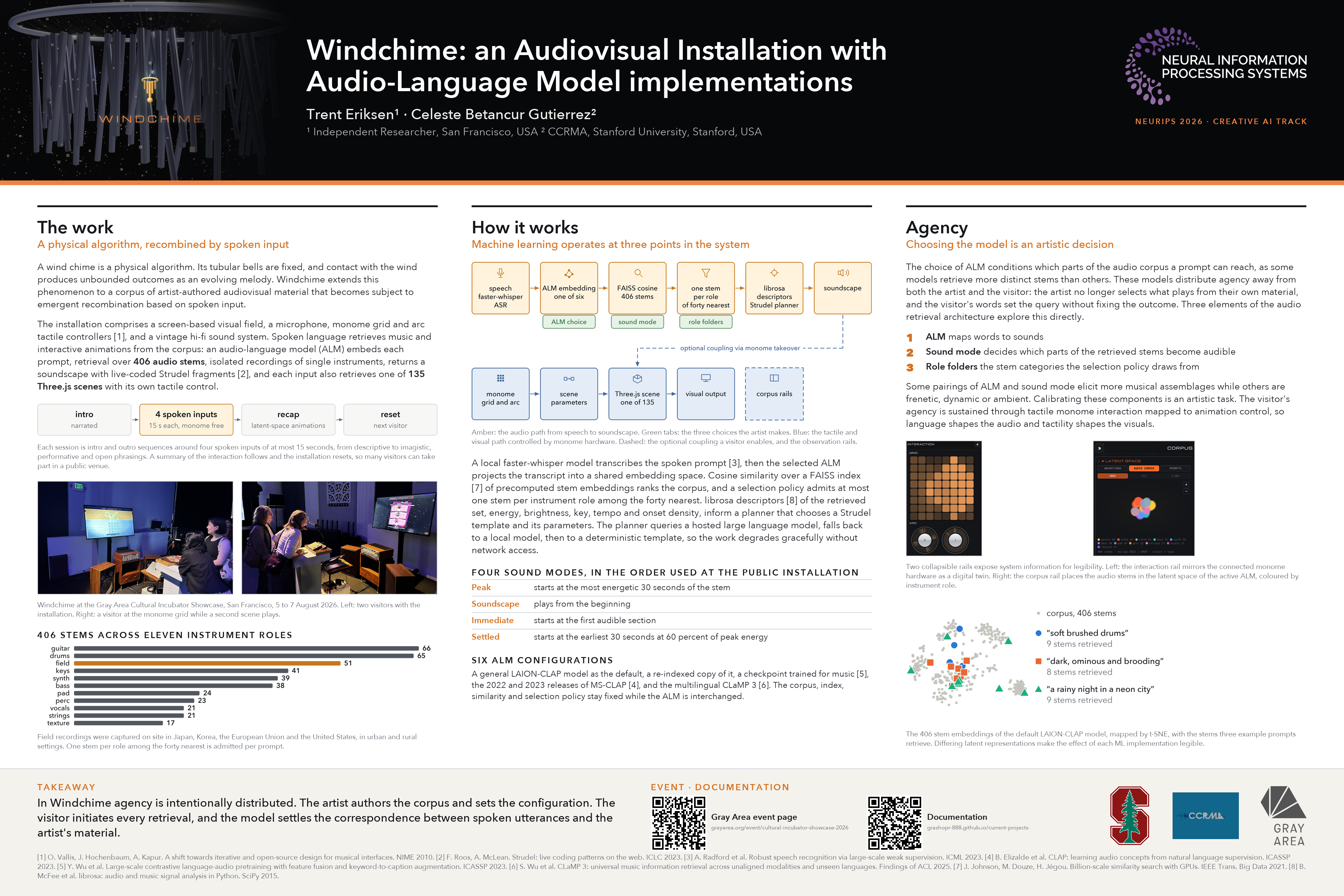
Windchime is an audiovisual installation in which spoken language retrieves music and interactive animations from an artist authored corpus. A local Automatic Speech Recognition (ASR) model transcribes each prompt, an audio-language model (ALM) embeds it and retrieval over 406 audio stems returns a mix with live coded Strudel fragments that layer into audio output. Simultaneously each visitor’s input results in retrieval of interactive Three.js animation scenes each containing unique tactile control via monome grid and arc hardware. Windchime distributes agency in three distinct directions; across the artist who authored the possible outputs, the ALM that influences what areas of the corpus can be retrieved, and the visitor who’s spoken inputs result in multimodal embodied interaction.
Wishstone: Negotiating Voice Agency Through a Tangible Generative Keepsake
Dingning Cao ⋅ Max Zhu ⋅ Haoxi R Zhang ⋅ Marcelo Coelho
Voice-cloning tools typically let an operator script what another person appears to say. Such control is ill-suited to a generative keepsake, which should create new, personal speech without letting the recipient dictate the contributor’s words. We present Wishstone, a promptless tangible voice keepsake in which a contributor authorizes a cloned voice and supplies personal memories, while a recipient can invoke a model-authored message by placing a stone. Wishstone implements this interaction through an anecdote-to-voice pipeline that prescreens generated text, synthesizes it in the contributor’s cloned voice, and encrypts it for local playback. In a preliminary formative evaluation with six recipients, participants reported that the messages felt personally grounded and that placement gave them control over when the voice was heard. They attributed influence to multiple actors but assigned most harmful-output responsibility to designers and AI services. These findings suggest that creative agency can be distributed across an interface while accountability may remain concentrated on those who design and provide its gen- erative system.