
Neural Networks Generalize on Low Complexity Data
Sourav Chatterjee ⋅ Timothy Sudijono
2025 Poster
Abstract
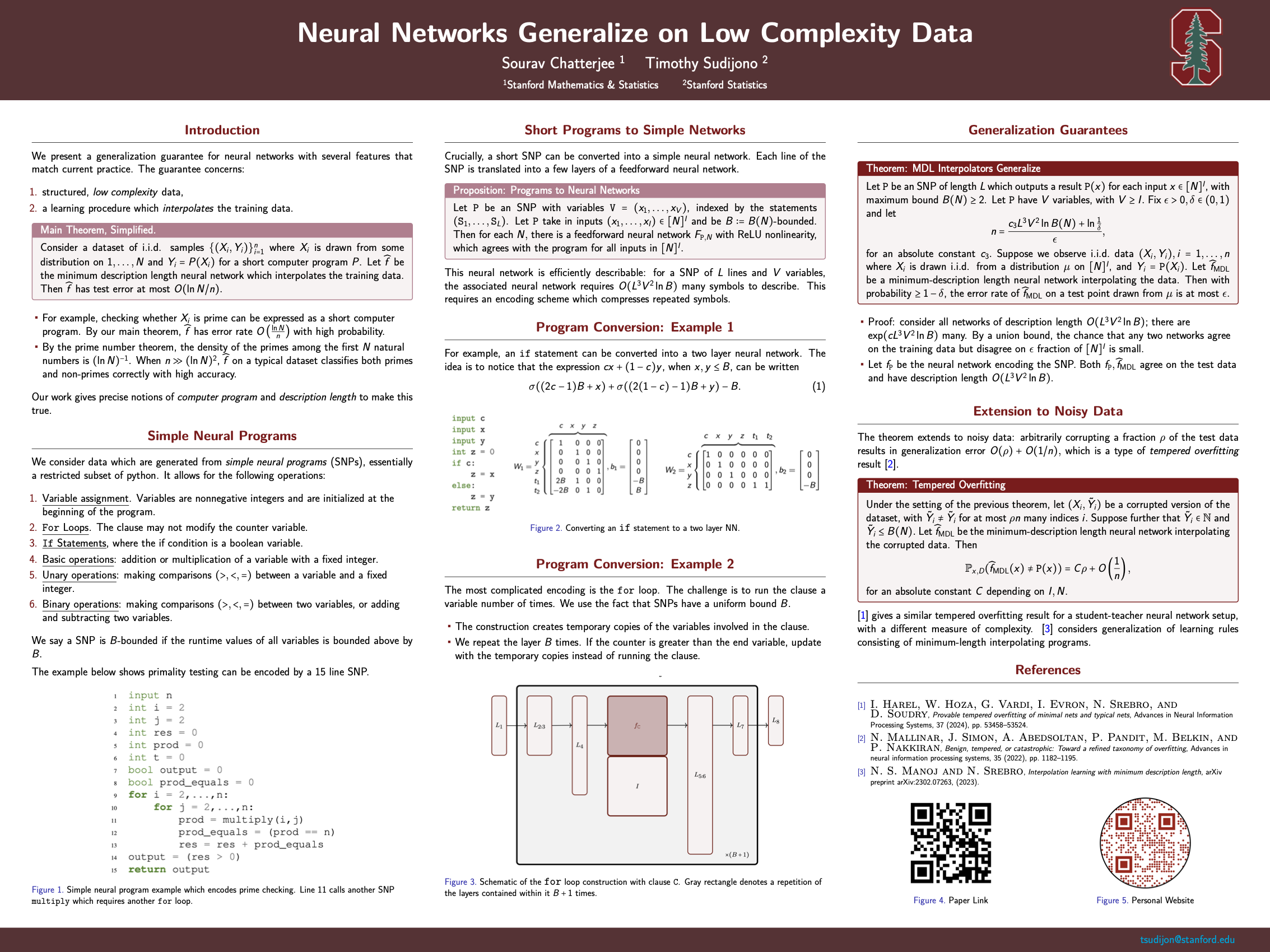
We show that feedforward neural networks with ReLU activation generalize on low complexity data, suitably defined. Given i.i.d.~data generated from a simple programming language, the minimum description length (MDL) feedforward neural network which interpolates the data generalizes with high probability. We define this simple programming language, along with a notion of description length of such networks. We provide several examples on basic computational tasks, such as checking primality of a natural number. For primality testing, our theorem shows the following and more. Suppose that we draw an i.i.d.~sample of $n$ numbers uniformly at random from $1$ to $N$. For each number $x_i$, let $y_i = 1$ if $x_i$ is a prime and $0$ if it is not. Then, the interpolating MDL network accurately answers, with error probability $1- O((\ln N)/n)$, whether a newly drawn number between $1$ and $N$ is a prime or not. Note that the network is not \textit{designed} to detect primes; minimum description learning \textit{discovers} a network which does so. Extensions to noisy data are also discussed, suggesting that MDL neural network interpolators can demonstrate tempered overfitting.
Video
Chat is not available.
Successful Page Load