
Multi-SWE-bench: A Multilingual Benchmark for Issue Resolving
Abstract
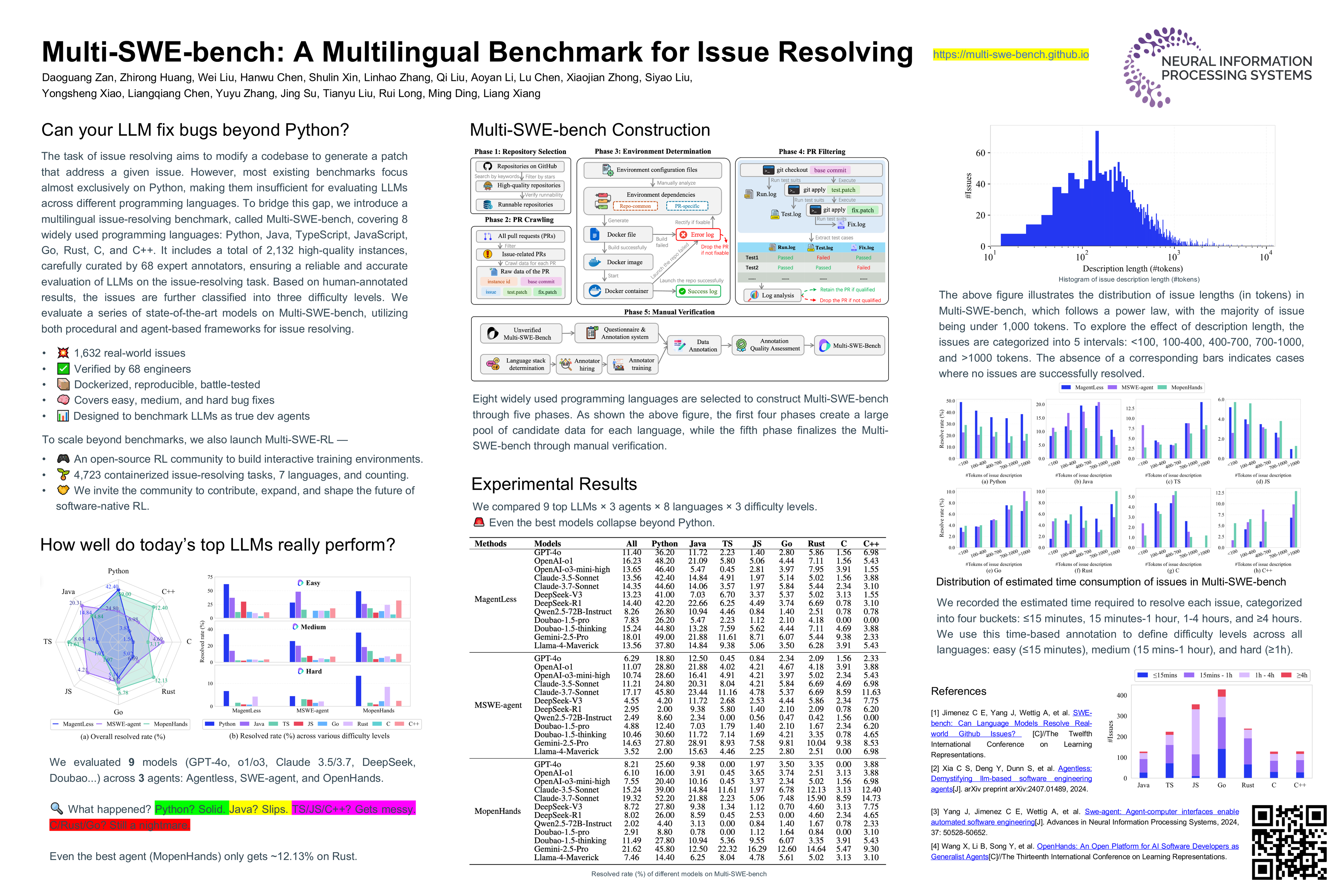
The task of issue resolving aims to modify a codebase to generate a patch that addresses a given issue. However, most existing benchmarks focus almost exclusively on Python, making them insufficient for evaluating Large Language Models (LLMs) across different programming languages. To bridge this gap, we introduce a multilingual issue-resolving benchmark, called Multi-SWE-bench, covering 8 languages of Python, Java, TypeScript, JavaScript, Go, Rust, C, and C++. In particular, this benchmark includes a total of 2,132 high-quality instances, carefully curated by 68 expert annotators, ensuring a reliable and accurate evaluation of LLMs on the issue-resolving task. Based on human-annotated results, the issues are further classified into three difficulty levels. We evaluate a series of state-of-the-art models on Multi-SWE-bench, utilizing both procedural and agent-based frameworks for issue resolving. Our experiments reveal three key findings: (1) Limited generalization across languages: While existing LLMs perform well on Python issues, their ability to generalize across other languages remains limited; (2) Performance aligned with human-annotated difficulty: LLM-based agents' performance closely aligns with human-assigned difficulty, with resolution rates decreasing as issue complexity rises; and (3) Performance drop on cross-file issues: The performance of current methods significantly deteriorates when handling cross-file issues. These findings highlight the limitations of current LLMs and underscore the need for more robust models capable of handling a broader range of programming languages and complex issue scenarios.