
AneuG-Flow: A Large-Scale Synthetic Dataset of Diverse Intracranial Aneurysm Geometries and Hemodynamics
Abstract
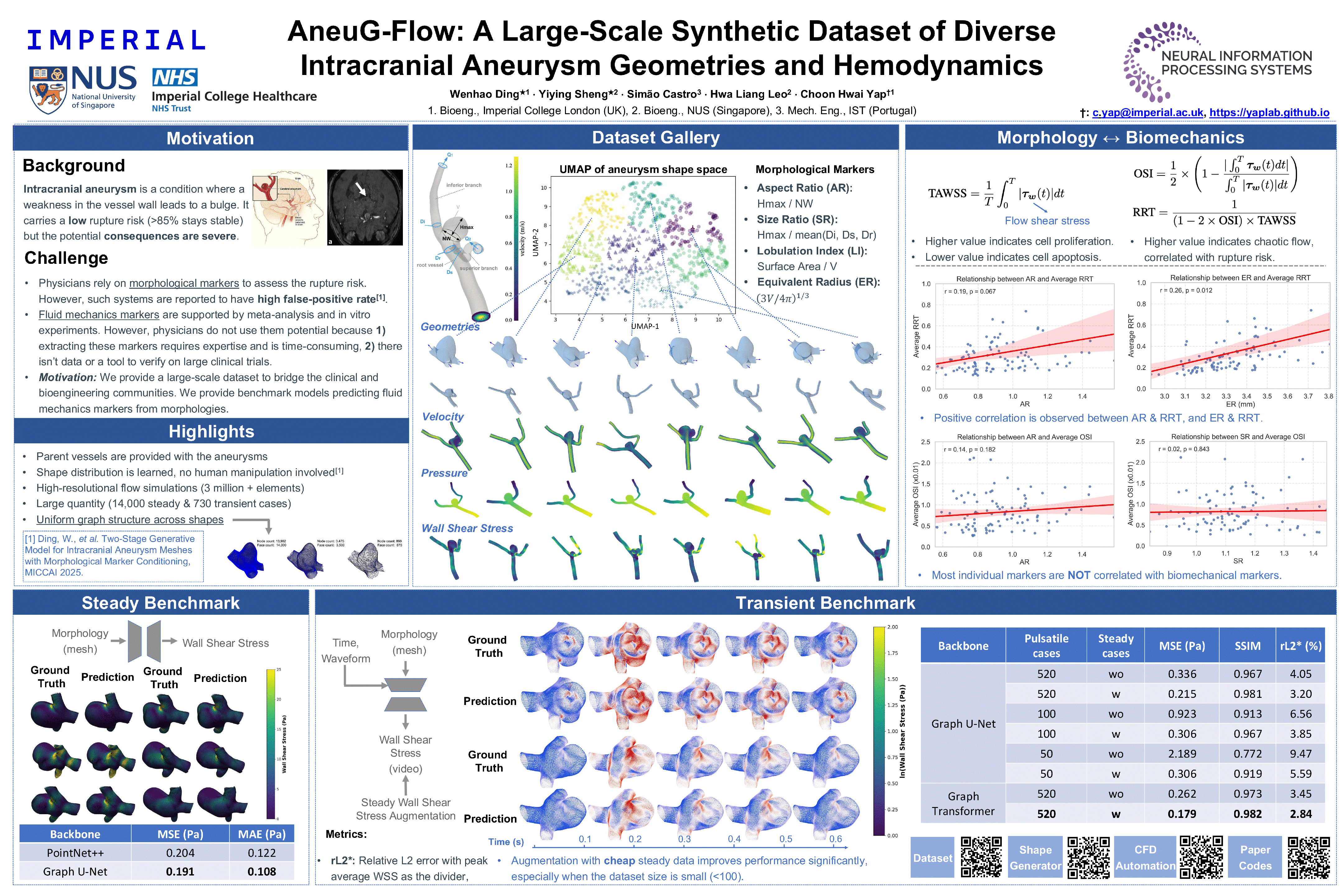
Hemodynamics has a substantial influence on normal cardiovascular growth and disease formation, but requires time-consuming simulations to obtain. Deep Learning algorithms to rapidly predict hemodynamics parameters can be very useful, but their development is hindered by the lack of large dataset on anatomic geometries and associated fluid dynamics. This paper presents a new large-scale dataset of intracranial aneurysm (IA) geometries and hemodynamics to support the development of neural operators to solve geometry-dependent flow governing partial differential equations. The dataset includes 14,000 steady-flow cases and 200 pulsatile-flow cases simulated with computational fluid dynamics. All cases are computed using a laminar flow setup with more than 3 million cells. Boundary conditions are defined as a parabolic velocity profile with a realistic waveform over time at the inlet, and geometry-dependent mass flow split ratios at the two downstream outlets. The geometries are generated by a deep generative model trained on a cohort of 109 real IAs located at the middle cerebral artery bifurcation, capturing a wide range of geometric variations in both aneurysm sacs and parent vessels. Simulation results shows substantial influence of geometry on fluid forces and flow patterns. In addition to surface mesh files, the dataset provides volume data of velocity, pressure, and wall shear stresses (WSS). For transient cases, spatial and temporal gradients of velocity and pressure are also included. The dataset is tested with PointNet and graph U-Nets for WSS prediction, which showed relative L2 loss of 4.67\% for normalized WSS pattern.