
Fast-in-Slow: A Dual-System VLA Model Unifying Fast Manipulation within Slow Reasoning
Abstract
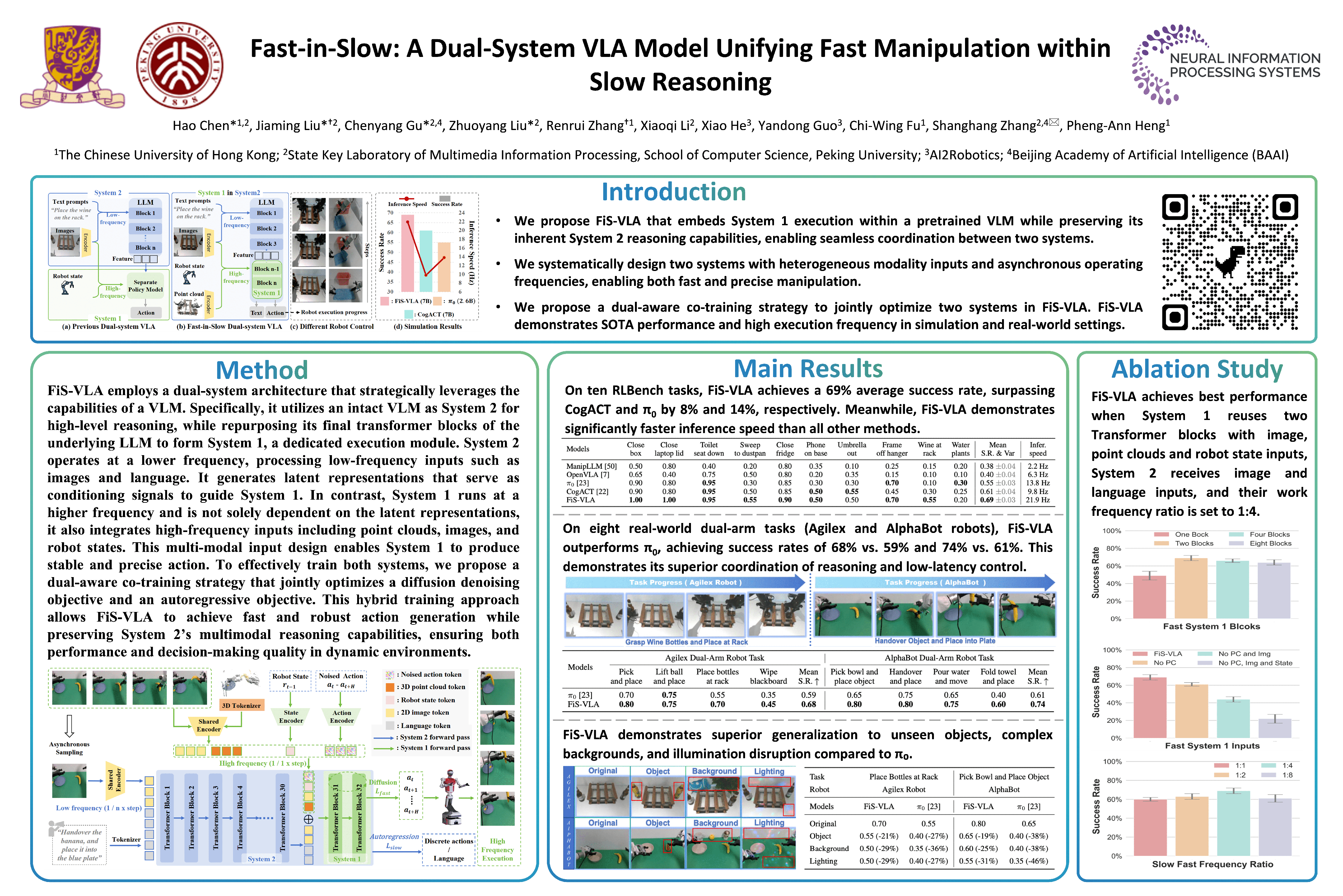
Generalized policy and execution efficiency constitute the two critical challenges in robotic manipulation. While recent foundation policies benefit from the common-sense reasoning capabilities of internet-scale pretrained vision-language models (VLMs), they often suffer from low execution frequency. To mitigate this dilemma, dual-system approaches have been proposed to leverage a VLM-based System 2 module for handling high-level decision-making, and a separate System 1 action module for ensuring real-time control. However, existing designs maintain both systems as separate models, limiting System 1 from fully leveraging the rich pretrained knowledge from the VLM-based System 2. In this work, we propose Fast-in-Slow (FiS), a unified dual-system vision-language-action (VLA) model that embeds the System 1 execution module within the VLM-based System 2 by partially sharing parameters. This innovative paradigm not only enables high-frequency execution in System 1, but also facilitates coordination between multimodal reasoning and execution components within a single foundation model of System 2. Given their fundamentally distinct roles within FiS-VLA, we design the two systems to incorporate heterogeneous modality inputs alongside asynchronous operating frequencies, enabling both fast and precise manipulation. To enable coordination between the two systems, a dual-aware co-training strategy is proposed that equips System 1 with action generation capabilities while preserving System 2’s contextual understanding to provide stable latent conditions for System 1. For evaluation, FiS-VLA outperforms previous state-of-the-art methods by 8% in simulation and 11% in real-world tasks in terms of average success rate, while achieving a 117.7 Hz control frequency with action chunk set to eight. Project web page: https://fast-in-slow.github.io.