
Improving Arabic-English Translation for Humanitarian Response Efforts via Open LLMs with In-Context Learning
Abstract
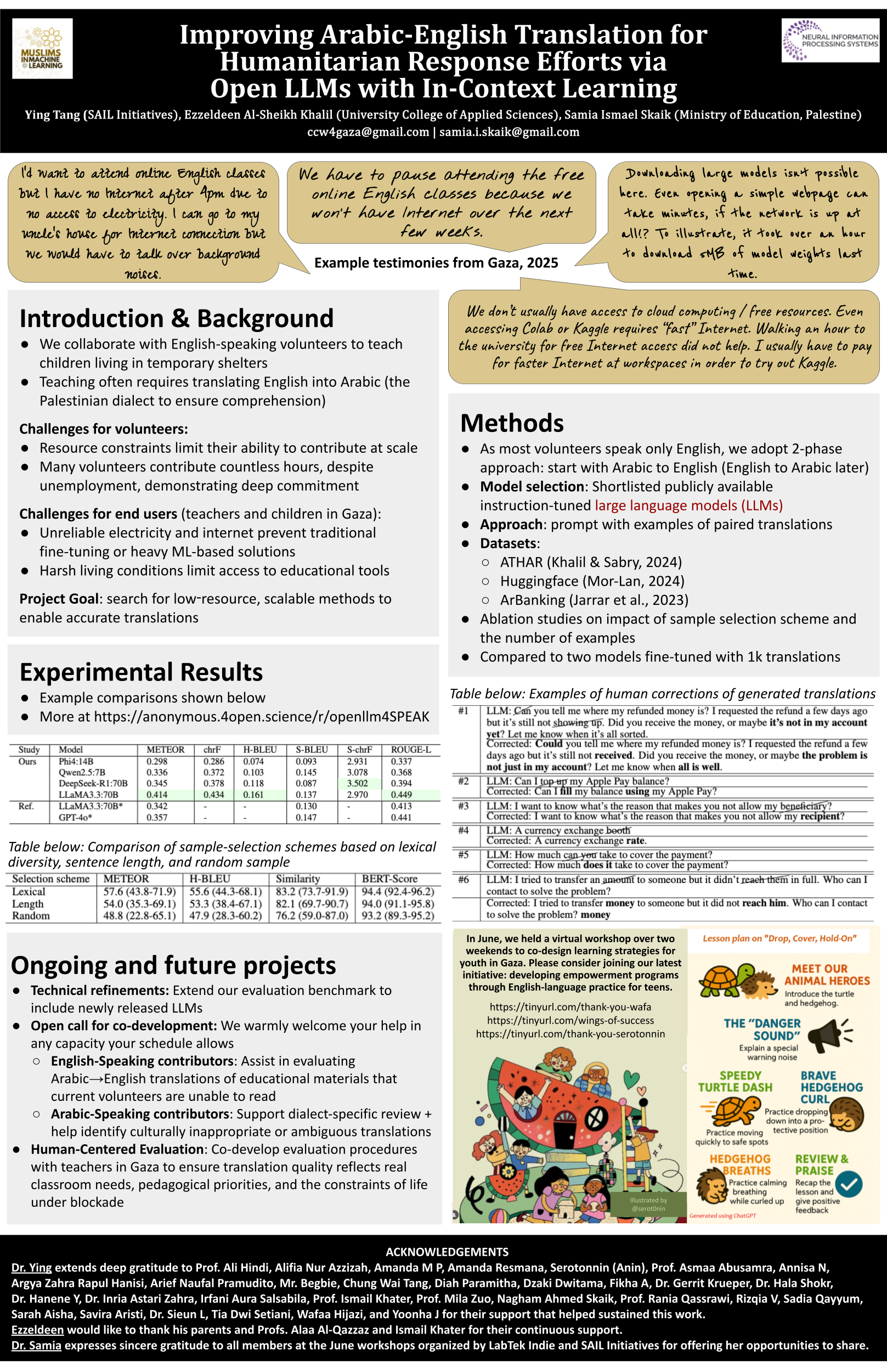
A key step in humanitarian relief in low-resource settings is making translation tools easily accessible. Once validated, these tools enable improved access to educational materials, healthcare information, and other essential resources. Many existing Arabic-to-English translation services require Internet access or paid subscriptions, while non-proprietary approaches typically require powerful computers, which are often infeasible for communities with limited or unreliable connectivity and electricity. This study advocates a non-proprietary approach based on open-weight large language models and in-context learning, a strategy that enables these models to learn from a few examples without expensive retraining of models. We tested various open-weight models, including Meta’s LLaMA3.3, Google’s Gemma2, and Alibaba’s Qwen2.5, to evaluate their Arabic-to-English translation performance. According to various quantitative metrics, our experimental results show that using 3 to 15 examples progressively enhanced translations accuracy, and that using the entire training corpus to fine-tune commonly used models did not yield performance gains. Additional subjective evaluations by native speakers revealed limitations that may be addressed by including examples of idiomatic expressions and other colloquial data. By identifying effective and lightweight translation tools, this work contributes to the development of digital tools that can support long-term recovery and resilience-building efforts in Gaza. To make our experiments accessible to the community, our analysis scripts will be continuously updated and made available at https://anonymous.4open.science/r/openllm4SPEAK.