
Q-CatNet: Leveraging Quantum and Graph Features for Catalyst Simulation and Discovery
Abstract
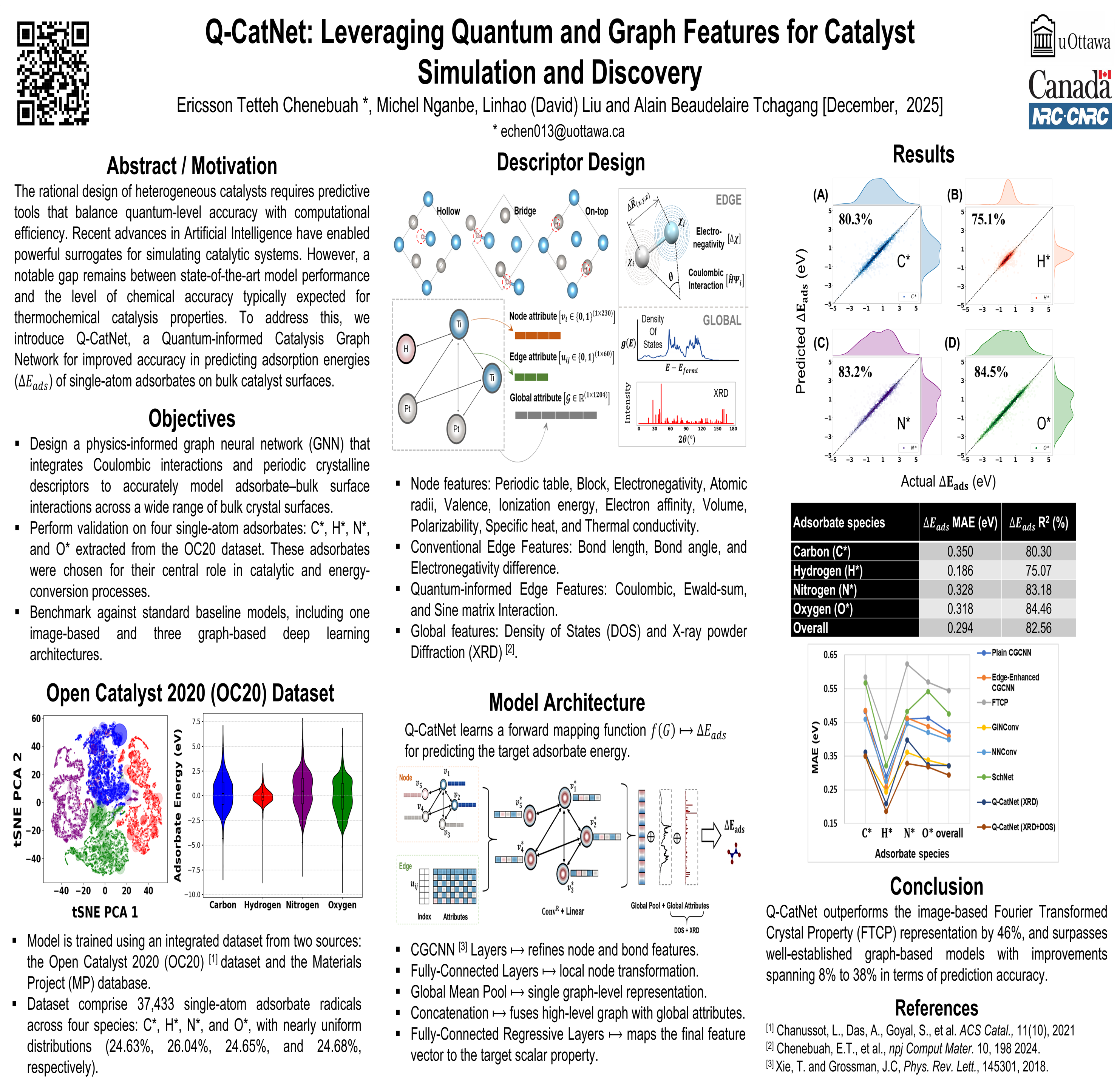
The rational design of heterogeneous catalysts demands predictive tools that balance quantum-level accuracy with efficiency. We present Q-CatNet, a Quantum-informed Crystal Network derived from the Crystal Graph Convolutional Neural Network (CGCNN) model that integrates enriched edge descriptors with global state attributes to capture both local and system-wide physics. Ablation studies show that edge features alone yield only marginal gains over a plain CGCNN, while the joint edge–global representation in Q-CatNet achieves a Mean Absolute Error (MAE) score of 0.294 eV, improving accuracy by ~30%. Benchmarking against baselines confirms its robustness: Q-CatNet outperforms the image-based Fourier Transformed Crystal Property (FTCP) representation by 46% and surpasses three state-of-the-art graph-based architectures for material informatics, namely GINConv, NNConv, and SchNet, by margins ranging from 8% to 38%. These results highlight Q-CatNet as a generalizable and physically consistent framework for accelerating adsorption energy prediction, offering a practical route toward efficient catalyst screening and discovery.