
In Search of the Unknown Unknowns: A Multi-Metric Distance Ensemble for Out of Distribution Anomaly Detection in Astronomical Surveys
Abstract
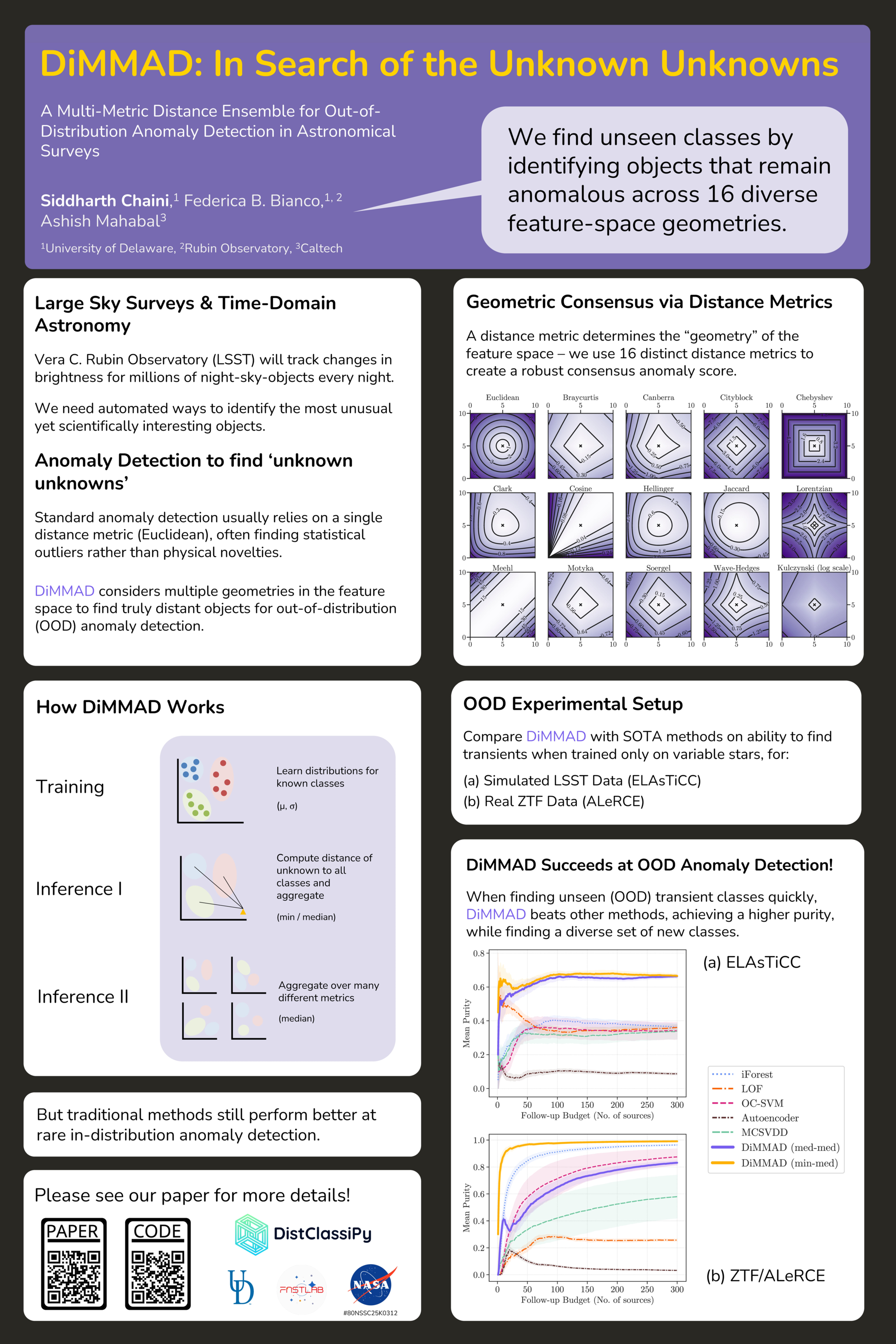
Distance-based methods involve the computation of distance values between features and are a well-established paradigm in machine learning. In anomaly detection, anomalies are identified by their large distance from normal data points. However, the performance of these methods often hinges on a single, user-selected distance metric (like Euclidean distance), which may not be optimal for the complex, high-dimensional feature spaces common in astronomy. Here, we introduce DiMMAD: Distance Multi-Metric Anomaly Detection, a novel anomaly detection method that uses an ensemble of distance metrics to find novelties. Using multiple distance metrics is effectively equivalent to using different geometries in the feature space. By using a robust ensemble of diverse distance metrics, we overcome the metric-selection problem, creating an anomaly score that is not reliant on any single definition of distance. We demonstrate this multi-metric approach as a tool for simple, interpretable scientific discovery on astronomical time series -- (1) with simulated data for the upcoming Vera C. Rubin Observatory Legacy Survey of Space and Time, and (2) real data from the Zwicky Transient Facility. We find that DiMMAD excels at out-of-distribution anomaly detection -- anomalies in the data that might be new classes -- and beats other state-of-the-art methods in the goal of maximizing the diversity of new classes discovered. For rare in-distribution anomaly detection, DiMMAD performs similarly to other methods, but allows for improved interpretability. DiMMAD is open-source and available on https://anonymous.4open.science/r/DiMMAD-34C7.